


3 Reasons Why the “Eat Less, Move More” Approach Fails Teenagers With Insulin Resistance

If you have ever stood in your kitchen, watching your teenager, wondering why nothing you try seems to work — I want you to take a breath before you read another word. You are not doing this wrong. And neither is your teen.
Maybe you have already spent late nights searching things like signs of insulin resistance in teens, or how to improve insulin sensitivity in adolescents without dieting, or even a pediatric weight management program that doesn't focus on dieting. If so, you are in exactly the right place — because that instinct, the one telling you there has to be a better way than another diet, is correct.
The “eat less, move more” advice has been around for decades. It sounds sensible. It sounds scientific. And if you have ever said it to your teenager, or heard it from their doctor and nodded along, I completely understand why. I would have nodded too.
Why I Created This Post
Let me tell you something personal, because it is the reason I do this work at all.
When I was around 11 or 12, I was an overweight kid who desperately wanted to feel better in my body. My cousin told me I should go on a diet. She said tomatoes would help, because tomatoes have almost no calories. So I tried it. Tomatoes with feta cheese, tomatoes with bread, tomatoes while I watched my favourite shows after school, hungry and hopeful and certain that this time it would work
It did not work.
And here is the part I think about now. My first instinct was that the problem was the tomatoes — not the idea of restricting food in the first place. So I assumed that if I could just find the right restricted food, the magic food, then it would finally click.
Decades later, as a pediatric endocrinologist, I understand that the tomato was never the problem. The whole idea of restriction as the answer for a growing teenager was the problem. And “eat less, move more” is simply the grown-up, more respectable-sounding version of my tomato diet. It sounds logical. BUT for a teenager dealing with insulin resistance, prediabetes, PCOS, or weight changes during puberty, it misses the point entirely.
One quick note before we go further. If you have been searching for a diet for teen insulin resistance management, I want to gently challenge that one word — diet — because the goal here is never restriction. It is helping your teen's body work the way it is meant to. The real aim is preventing prediabetes by calming insulin levels, not by counting and cutting.
In this post, I want to walk you through three specific, science-backed reasons “eat less, move more” keeps failing teenagers with insulin resistance— and what actually helps instead. Because there is a better way. And once you understand the biology, everything clicks into place.
Why the Eat Less, Move More Advice Gets a Teenager's Biology Wrong
Before I get into the three reasons, I want to say one thing clearly, and I want you to really let it land.
If your teenager has been told to eat less and move more, tried it, and it did not work — that is not a reflection of their character. This has nothing to do with willpower or how hard they tried. The real issue is that this advice was built for adult bodies and handed to a teenager whose body is doing something completely different
Teenagers are not small adults. Their bodies are in the middle of one of the most hormonally complex stretches of human development. Generic calorie-cutting advice was never designed with that in mind.
Let me show you exactly why.
3 Reasons Eat Less, Move More Fails Teenagers
Reason 1: Teenagers Are Still Growing — and Need More, Not Less
The first and most basic reason this approach fails is that it ignores something obvious the moment you say it out loud: teenagers are growing.
An adult body is relatively stable. Once you have reached your adult height and your development is mostly finished, figuring out how much food you need is fairly straightforward. A teenager is a moving target.
A teen's nutritional needs shift constantly — with their age, their growth spurts, their height, their activity. A 14-year-old who plays competitive soccer four afternoons a week needs something completely different from a 14-year-old who comes home, does homework, and unwinds in front of a screen. Handing both of them the same “eat less” instruction is not just unhelpful. For the active one, it can actually get in the way of the growing their body is trying to do.
What Teenagers Actually Need to Grow Through Puberty
Teenagers need carbohydrates, protein, and fat to move through puberty the way they are supposed to. These are not optional. They are the raw materials for the hormonal changes, the muscle, the bone growth that puberty is built on. Cutting them back without thoughtful guidance can interfere with normal development in ways that reach far past the number on a scale.
If you genuinely want to know what your teenager needs, the people to ask are a pediatric endocrinologist or a registered dietitian who works with adolescents. This is exactly why so many parents end up searching for a pediatric nutritionist for insulin resistance — they sense that “just eat less” is not an answer. And they are right. It is a shortcut that skips the most important part of the question.
This is why the American Academy of Pediatrics, in its clinical practice guidelines on children and adolescents with obesity, points toward individualized, supported lifestyle change rather than blanket calorie restriction — because a teenager's needs are fundamentally different from an adult's.
Reason 2: The Advice Ignores the Hormonal Reality of Puberty
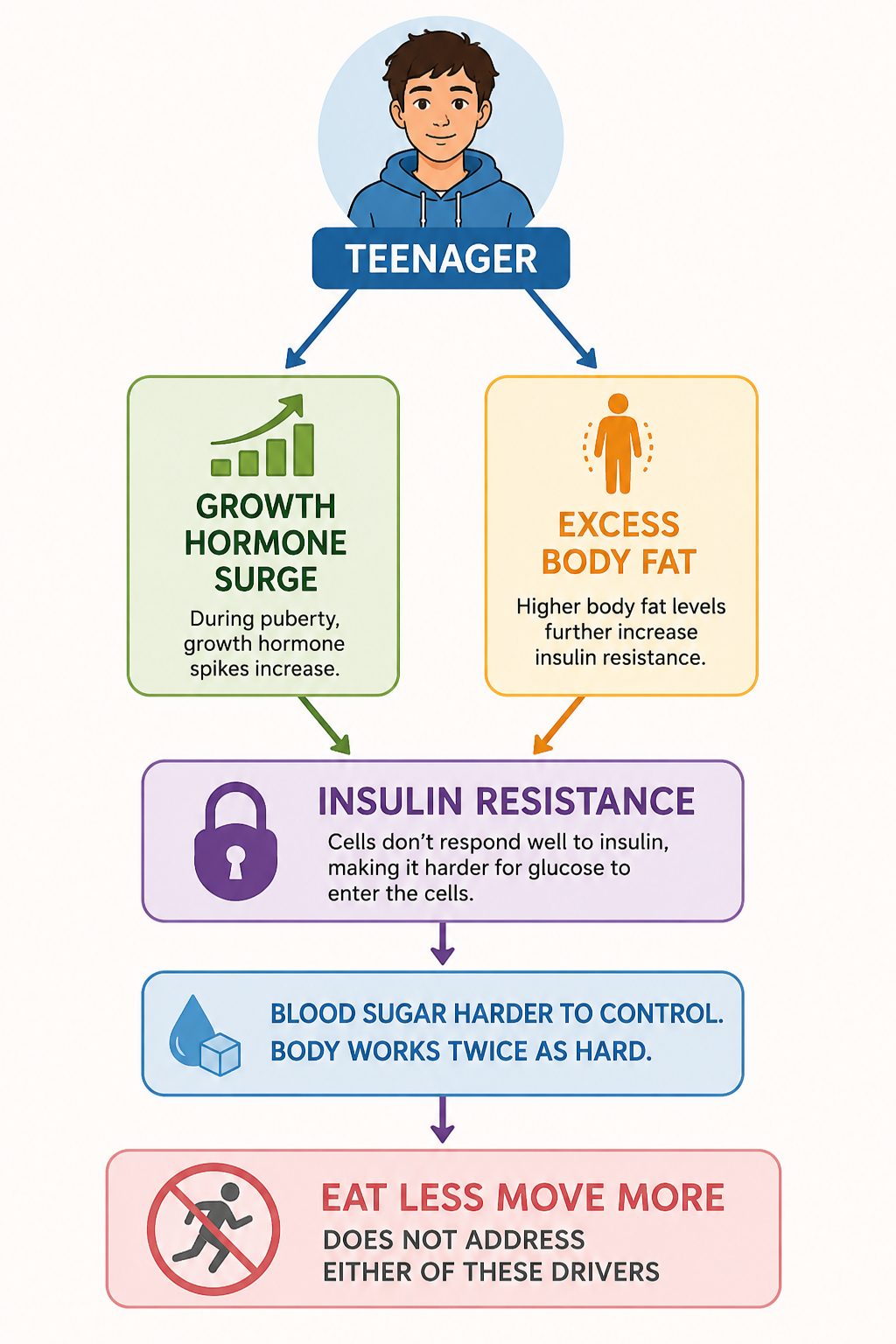
This is the reason I feel most strongly about, because it is the one that explains why so many teenagers struggle even when they are honestly, sincerely trying their hearts out.
During puberty, the body pumps out high levels of growth hormone to fuel everything that is developing. Growth hormone during puberty is necessary, normal, and exactly what is supposed to happen. BUT that same growth hormone also causes a real drop in insulin sensitivity. Research in Pediatric Research, backed by multiple long-term studies, has shown that insulin sensitivity falls by roughly 25 to 30 percent during the pubertal years.
In plain language: a teenager's body has to make significantly more insulin than an adult's to handle the very same meal. The demand is higher. The hormonal load is heavier. The whole environment is simply harder to work with — through no fault of your teen's at all.
A 2024 review in Pediatric Diabetes confirmed that insulin resistance in adolescents involves several overlapping pieces — pubertal growth hormone surges, extra body fat, and inflammatory pathways — and not one of them is touched by “eat less and exercise more.”
Now layer extra weight on top of that. Body fat, particularly around the middle, independently lowers insulin sensitivity too. So a teenager who enters puberty already carrying extra weight is meeting insulin resistance from two directions at once — one coming from puberty hormones, one from body composition. Two waves, at the same time. Imagine being asked to swim against that and then being told you simply are not trying.
“Eat less, move more” answers neither of those waves. The growth hormone surge cannot be slowed, and it should not be. Puberty needs to happen. Directly improving insulin sensitivity is also something this advice does not address. It simply says eat less
Why Food Quality Beats Calorie Counting for Teenagers With Insulin Resistance
What does speak to puberty-driven insulin resistance is food quality — protein, fiber, vegetables, and whole-food carbohydrates that work with the body's hormones instead of ignoring them. And movement that builds muscle, because muscle is one of the main places the body burns through glucose and improves its insulin response.
Take the same number of calories — say, a fast-food burger on one hand, and Greek yogurt, grilled chicken, a salad, and whole-grain bread on the other. The number is identical. But for a teenager with insulin resistance, the effect on their body is worlds apart. One sets off repeated insulin spikes. The other keeps blood sugar steady through the day.
This does not mean the amount of food is meaningless — it still matters, and the AAP recommends nutrient-dense foods in a sensible range. The point is simply that what your teen eats changes their biology in ways the number alone can never capture. And for a teen with insulin resistance, that one distinction changes everything about how we should be feeding them.
This is the shift that actually moves the needle. Not less food. Better food.
For a fuller picture of how puberty insulin resistance develops and what it means for your teenager, read my detailed post on insulin resistance in teens.
Reason 3: Forced Movement Does Not Last — and Going It Alone With Restriction Can Hurt
The third reason is the most human one. And I want to be honest with you here, because I lived it.
I hated PE. Not because I was lazy. Because I was always the last one when the teacher sent us running laps around the field. Out of breath. Red in the face. Watching everyone else finish while I was still going. And every single session quietly hammered home the same message: you are bad at this, and exercise is something that happens TO you, not something you could ever enjoy.
That feeling kept me away from movement for years. It was not until much later that I realized the problem was never my body. The problem was the format.
Think about how many people join a gym in January because they feel like they have to. The place is packed. Then March rolls around, and it is a ghost town. That happens because movement that feels like an obligation almost never sticks. It is a short-lived change powered by fear or pressure, and it melts away the moment the pressure lets up.
For a teenager, this is even truer. A teen who exercises because the doctor said so, or because a worried parent is hovering, or because they are frightened of what comes next, will do it for a little while. Then the novelty fades, the motivation drains, and they drift back to where they started — often feeling worse about themselves than when they began.
What Research Found
What research and real-life experience keep showing us is that for a teenager, movement has to be enjoyable and social before it becomes a habit. Basketball with friends. Dancing in their room. Swimming. Biking. Rock climbing. Almost anything a teen actually likes will outlast a prescribed routine they grit their teeth through.
The same is true for food. Teenagers who quietly put themselves on restrictive diets, with no support, are at much higher risk of slipping into disordered eating. The AAP is clear that restrictive dieting on its own can leave kids undernourished, set them up to binge after restricting, and push them toward harmful patterns. And this is the crucial part: that risk lives in the unsupervised, do-it-alone dieting at home — not in supported programs.
In fact, structured programs guided by a professional have been shown to reduce disordered eating, not feed it. So please hear this: the danger was never in seeking help for your teen. The danger is in white-knuckling restriction alone, without anyone in your corner. This is precisely why a body-positive, no-shame approach matters so much for teens — and why so many parents go looking for it.
If you want to know which foods are quietly working against your teenager's insulin levels — even ones that look perfectly healthy — my post on healthy foods that spike insulin in teenagers covers it in detail.
How to Improve Insulin Sensitivity in Teens Without Dieting
Before I share this, I want to say one thing, because I know how heavy all of this can feel. None of what follows is about perfection. It is about direction. Pick the one thing that feels most doable for your family this week, and start there. That is enough.
This is the heart of how to improve insulin sensitivity in adolescents without dieting — no counting, no cutting, no shame. Just a handful of shifts that work with your teen's biology.
Focus on Food Quality, Not Quantity
The goal is not to eat less. The goal is to eat better. Those are two very different things, and the difference matters enormously for how your teen feels about food.
In practice, that looks like swapping sugary drinks for water — honestly the single highest-impact change most families can make, starting today. It looks like making sure there is a real source of protein at breakfast, lunch, and dinner, because protein steadies blood sugar and keeps your teen full and even-keeled for longer. And it looks like leaning into whole-food carbohydrates — lentils, fruit, vegetables, whole grains — over the processed ones like chips, white bread, and sweetened cereal.
None of this requires counting a single thing. It is about what makes it into the kitchen and onto the plate.
For free, high-protein meal ideas built for teenagers that take under 30 minutes, grab my 30 free recipes at lifestyleforteens.com/recipes.
Make Movement Something Your Teen Actually Enjoys
Ask your teenager what they like doing. Not what they should do. What they genuinely enjoy. Dancing? Basketball? Swimming? Hiking? Whatever the answer, that is your starting point.
The guidance points to about 60 minutes of movement a day for teens, and that is a very reachable goal once movement is fun and social. It does not have to be structured, and neither does it have to happen in a gym. It just has to happen often enough to become part of life.
Adding some strength work a couple of times a week is especially worth it for a teen with insulin resistance, because building muscle directly improves how the body handles insulin. But — same rule — it sticks best when your teen chooses it, not when it is handed down as a chore.
Involve the Whole Family
Teenagers who make changes that actually last almost always make them with their family beside them. When the whole household shifts together — when everyone is eating a little differently and moving a little more — your teen is not singled out, not shamed, not fighting alone in a house full of the old patterns.
This is not about one person's situation. It is about building a household where health is just how your family lives. That framing lifts the stigma off your teen's shoulders and creates an environment where change can actually take root.
Do Not Forget Sleep and Stress
Two things “eat less, move more” never mentions are sleep and stress. Both matter enormously here.
Running on too little sleep directly worsens insulin resistance. Teenagers need 8 to 10 hours a night, and most are nowhere close. Consistent bedtimes, phones out of the bedroom, and easing off screens before bed are not lifestyle extras — they are part of the metabolic picture.
And chronic stress raises cortisol, which drives insulin resistance and cranks up cravings for sugary food. A teenager buried under academic pressure, social worry, or stress at home is fighting a hormonal battle every single day that no diet rule can fix. Emotional support, honest conversations, and gentle stress relief are not soft add-ons. They are real tools in turning insulin resistance around.
If You Have Been Searching for Real Help
If you have been typing things like certified holistic nutritionist for adolescents with prediabetes, body-positive nutritionist for teens, or safe online health and wellness coaching for teenagers into a search bar late at night, I see exactly what you are looking for. You want someone who takes a whole-child, hormone-first, no-shame approach — someone who will help your teen without making them feel like a problem to be fixed.
That is the entire reason 100 days LIFT Program (Lifestyle for Teens) exists. It is online wellness coaching designed for teens with insulin resistance and prediabetes, built around the body's hormones rather than around restriction — and led by a board-certified pediatric endocrinologist and certified health coach who has sat where you are sitting.
This Is Not Your Teenager's Fault — and There Is a Better Way
The “eat less, move more” advice was never built for the beautiful, complicated biology of adolescence. It ignores growing nutritional needs, puberty-driven insulin resistance, and the simple emotional reality of being a teenager. And when it fails — which it so often does — the teen is the one left holding the blame for “not trying hard enough.”
That blame is unfair, and it is just plain wrong. Struggling with weight and metabolic health during puberty is a hormonal story, not a character flaw. And the way through is an approach that actually speaks to those hormones.
So start with one change this week. Pour out the sugary drinks. Add some protein to breakfast. Take a walk together after dinner. These are not small things. Repeated quietly over months and years, they compound into a genuinely different path.
Small habits, built consistently, can have enormous results. That is not a motivational poster — that is what the science on teen metabolic health actually shows us, and it is the foundation of everything I do. Slow progress is the kind that sticks.
All the best, Dr Jenny
NEXT STEPS
If your teen needs support to build these habits, this is exactly why I created the 100-Day LIFT Program — a pediatric weight management program that does not focus on dieting at all. It addresses the root cause: dysregulated insulin and the hormonal patterns behind the constant hunger, fatigue, and weight gain so many teens are quietly carrying. Over 100 days, we focus on steady blood sugar, protein-forward food, better sleep, calmer stress, and the specific kinds of movement that genuinely improve insulin sensitivity in teenagers.
There is no calorie counting. No food restriction. No shame-based language — because none of that works when the issue is biological, not behavioral.
And this is not an app. Parents and teens get direct, live access to me throughout the program — real conversations, real answers, real support. Not a chatbot. Not a feedback form. A pediatric endocrinologist who knows your teen and is walking the process with you, week by week.
Reach out to learn more, or book a free call with me to see if it is the right fit for your family.
For weekly guidance on teen metabolic health, hormones, and nutrition, I also share something new every week on my Lifestyle and Weight Loss for Teens podcast.
Common Questions
How can I improve my teen's insulin sensitivity without dieting?
Why does “eat less, move more” not work for teenagers with insulin resistance?
Does puberty really make insulin resistance worse in teenagers?
About the Author
Dr. Jenny Gourgari, MD — Pediatric Endocrinologist & Obesity Medicine Specialist
Dr. Jenny is a board-certified Pediatric Endocrinologist and Obesity Medicine Specialist with 15+ years of experience helping teens with insulin resistance and prediabetes. She is the founder of Lifestyle for Teens and creator of the LIFT 100-Day Program. No diets. No shame. Just hormones that work.
Board Certified: Pediatric Endocrinology • Pediatrics • Obesity Medicine (ABOM) • MSc, Georgetown University • Full credentials →






No comment