


Will My Teenager Slim Down After Puberty? The Truth in 70% of Cases

Parents ask me will my teenager slim down after puberty all the time, usually framing it slightly differently depending on their situation. Will my daughter slim down once she finishes puberty? Will my son slim down once he stops growing. Is this extra weight just part of puberty, and will it simply go away on its own?
I want to answer this question honestly, because I think it matters enormously. If we assume this extra weight is just normal, temporary, physiologic puberty weight that will resolve itself, we tend not to do anything about it. And the research tells us that this assumption can have serious long-term consequences.
What Happens to Teen Weight Gain After Puberty? The Research
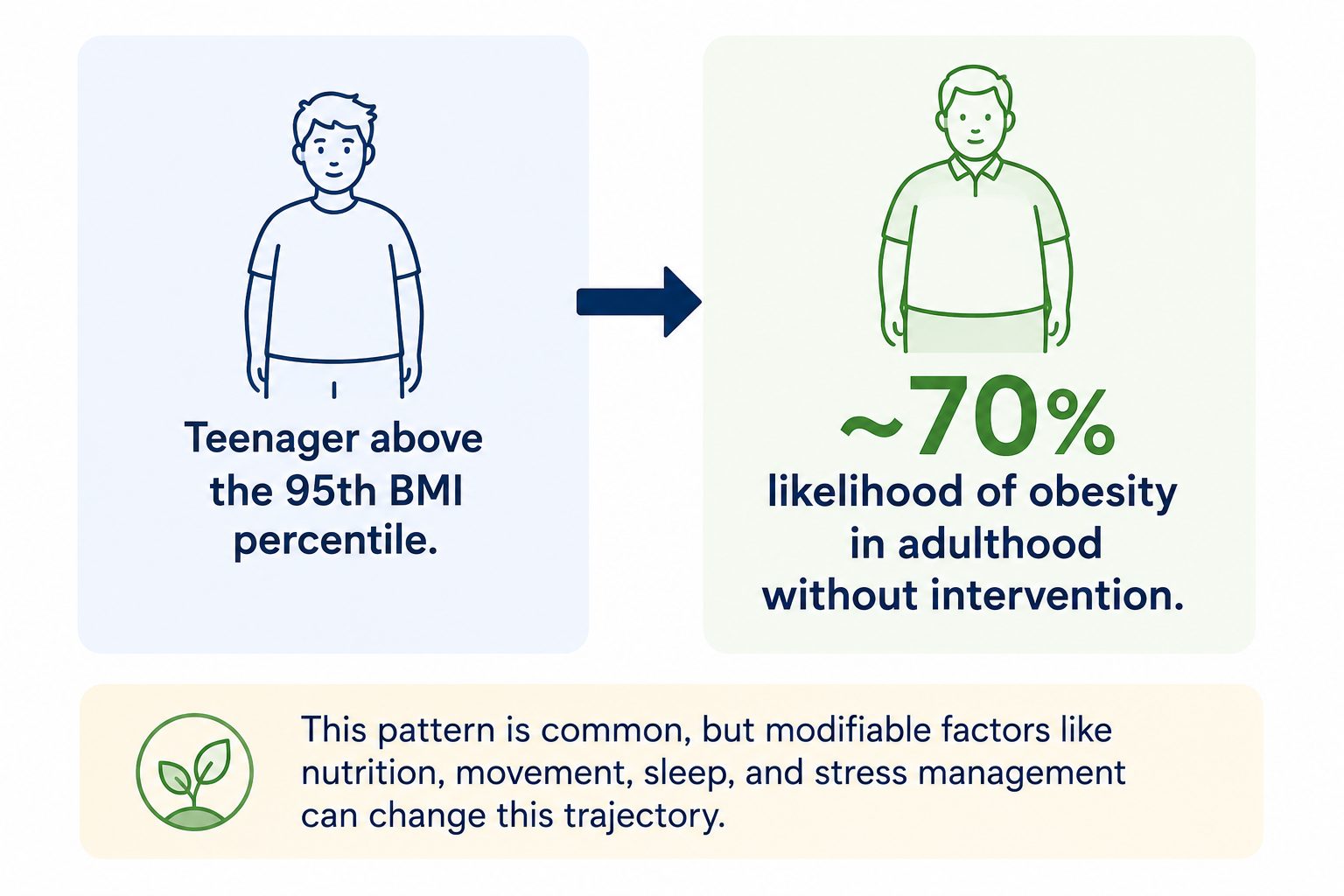
Here is what the research actually shows. Multiple long-term studies have tracked what happens to teenagers with obesity as they grow into adulthood, and the pattern is consistent and significant.
An evidence review conducted for the Agency for Healthcare Research and Quality, cited by the US Preventive Services Task Force, found that adolescents at or above the 95th BMI percentile, the clinical threshold for obesity, had approximately a 70 percent probability of having obesity as adults.
That is a significant number, and it directly answers the question of will my teenager slim down after puberty on their own. For most teenagers carrying excess weight without any lifestyle intervention, the pattern is far more likely to persist than to resolve naturally.
Other long-term research reinforces this. The National Longitudinal Study of Adolescent to Adult Health followed adolescents from their mid-teens into their late twenties and found that only about 8 percent of overweight adolescents and just 2 percent of adolescents with obesity returned to a normal BMI by adulthood.
This is exactly why I am so passionate about helping teenagers build healthier habits and balance their puberty hormones now, while they are still teenagers, rather than waiting and hoping the situation resolves on its own. The habits a teenager builds during these years are very often the habits that carry forward into their adult life.
Why This Matters: It's Not About the Number
I want to be very clear about something, because I do not want this post to create anxiety. This is not about a number on a scale, and it is not about appearance.
The reason this pattern matters is because of what tends to follow it. Teenagers who continue to carry excess weight into adulthood face a meaningfully higher risk for complications including type 2 diabetes, high blood pressure, obstructive sleep apnea, fatty liver disease, high cholesterol, and even stroke and heart attack later in life. These are serious, life-altering conditions, and many of them are genuinely preventable.
To understand the hormonal mechanisms driving many of these long-term risks, my post on insulin resistance in teens explains the underlying biology in more depth.
So Will My Teenager Slim Down After Puberty? Here's the Nuance
I want to give you the full, honest picture, because this is not a simple yes-or-no question.
Some degree of weight gain, and specifically fat gain, is genuinely expected and normal during puberty. This is not something to fight against. Teenage girls in particular tend to gain more fat around the thighs, chest, and belly as part of normal pubertal development. This happens to a lesser degree in boys too, partly because higher testosterone levels in boys tend to support more muscle development relative to fat.
This fat gain is not just expected; it is necessary. Without an adequate amount of body fat, both boys and girls cannot progress normally through puberty. They may not reach the height they are otherwise capable of. We absolutely do not want teenagers in extreme caloric restriction or malnourished during these critical growth years.
Where Normal Puberty Weight Ends and a Red Flag Begins
So where is the line? This is the genuinely important distinction.
If a teenager gains the weight and fat their body needs to progress through puberty normally, and they remain within a healthy BMI range for their age and sex, that is completely fine. That kind of weight gain is very likely to resolve naturally as their height catches up, exactly the way many parents hope.
But if a teenager's BMI rises above the healthy range, into the overweight or obesity category, that additional weight is not simply a normal consequence of puberty that will resolve on its own. This is the key insight behind the question of will my teenager slim down after puberty. Puberty itself does not reliably correct an unhealthy BMI. The research on long-term tracking confirms this clearly.
To find out exactly where your teenager's current weight stands and what counts as a healthy range for their age, my post on how much weight should my teenager lose walks through the calculation step by step.
The Good News: This Trend Is Genuinely Reversible
I do not want this post to leave you feeling like the path is fixed or unavoidable, because it is not.
Insulin resistance is reversible. An unhealthy BMI can shift toward a healthy one. High cortisol levels caused by chronic stress can come down with better stress management. Sleep, when improved, reduces the cravings that often drive overeating. Every one of these factors is genuinely modifiable, and when teenagers and parents put consistent energy and focus into changing them, real change happens.
This is also a meaningful opportunity from an identity standpoint. Teenagers are actively forming their sense of who they are during these years. That means this period is a genuine window to build a new identity around healthy habits, rather than carrying an old pattern forward simply because it feels familiar.
If your family has tried the typical eat less, move more advice without success, my post on why eat less move more fails teenagers explains why that approach misses the biology of puberty entirely, and what to do instead.
What Actually Helps: The Pillars of Healthy Habits
Building sustainable change does not require a dramatic overhaul. It comes down to a handful of consistent pillars, built gradually so they never feel like a restrictive diet.
- Healthy nutrition, focused on food quality rather than restriction
- Regular movement that your teenager genuinely enjoys
- Managing emotions in healthy ways, rather than through food
- Naturally supporting puberty hormones through sleep, nutrition, and stress management
- Strengthening the relationships and environment around your teenager, since support from family and friends makes consistency far easier
Each of these pillars, practiced consistently and built up slowly, compounds into a genuinely different lifestyle and a healthier long-term identity. None of them require perfection from day one.
For 30 free high-protein recipes that support these habits in a way that fits into real, busy teenage life, visit lifestyleforteens.com/recipes.
Start Now, Not Later
So, will my teenager slim down after puberty without any changes? For a teenager already within a healthy BMI range, likely yes, since the additional fat gained during puberty is a normal, temporary part of development. For a teenager whose BMI is above the healthy range, the research tells us this is unlikely to resolve through puberty alone.
This is not meant to create fear. It is meant to create clarity and motivation to act now, while your teenager is still growing and their habits are still forming, rather than waiting and hoping. The longer this pattern continues unaddressed, the more difficult it tends to become to change.
But please remember this is not about the number on the scale. It is about the effort and the habits. A teenager who is in an unhealthy BMI range but is actively building healthier habits is in a fundamentally different, more hopeful position than a teenager in the same BMI range who is not. The effort itself is the meaningful variable here, not the number alone.
Small, consistent habits, started today, really can change this trajectory and prevent the chronic health problems that tend to follow when this pattern continues unaddressed into adulthood.
NEXT STEPS
If your teen needs support to build these habits, this is exactly why I created the 100-Day LIFT Program — a pediatric weight management program that does not focus on dieting at all. It addresses the root cause: dysregulated insulin and the hormonal patterns behind the constant hunger, fatigue, and weight gain so many teens are quietly carrying. Over 100 days, we focus on steady blood sugar, protein-forward food, better sleep, calmer stress, and the specific kinds of movement that genuinely improve insulin sensitivity in teenagers.
There is no calorie counting. No food restriction. No shame-based language — because none of that works when the issue is biological, not behavioral.
And this is not an app. Parents and teens get direct, live access to me throughout the program — real conversations, real answers, real support. Not a chatbot. Not a feedback form. A pediatric endocrinologist who knows your teen and is walking the process with you, week by week.
Reach out to learn more, or book a free call with me to see if it is the right fit for your family.
For weekly guidance on teen metabolic health, hormones, and nutrition, I also share something new every week on my Lifestyle and Weight Loss for Teens podcast.
Frequently Asked Questions
Will my teenager slim down after puberty without doing anything?
It depends on where their BMI currently stands. If a teenager's BMI is within the healthy range, the additional fat gained during puberty is a normal part of development and is likely to balance out naturally as height increases. However, for teenagers whose BMI sits above the healthy range, the answer to will my teenager slim down after puberty is generally no, since research shows this pattern far more often persists into adulthood than resolves on its own.
What percentage of teenagers with obesity remain overweight as adults?
Research conducted for the Agency for Healthcare Research and Quality found that adolescents at or above the 95th BMI percentile, the clinical definition of obesity, had approximately a 70 percent probability of having obesity as adults. Other longitudinal research has found that only a small percentage of adolescents with obesity, around 2 percent in one major study, return to a normal BMI by adulthood without intervention.
Is gaining weight during puberty normal?
Yes, to a degree. Both boys and girls need to gain a certain amount of body fat to progress normally through puberty and reach their expected height. Teenage girls in particular tend to gain fat around the thighs, chest, and belly as part of typical pubertal development. The key distinction is whether this weight gain keeps a teenager within a healthy BMI range or pushes them above it.
Can an unhealthy BMI in a teenager be reversed?
Yes. Insulin resistance, elevated cortisol from stress, poor sleep, and an unhealthy BMI are all genuinely modifiable factors. When teenagers and parents focus consistent effort on nutrition quality, enjoyable movement, stress management, and sleep, real and lasting improvement is possible. This is one of the most encouraging findings in this area of research.
Why does it matter if a teenager's weight issue continues into adulthood?
Carrying excess weight from adolescence into adulthood meaningfully raises the risk of serious health complications, including type 2 diabetes, high blood pressure, obstructive sleep apnea, fatty liver disease, high cholesterol, stroke, and heart attack. Many of these conditions are preventable, which is why addressing the underlying habits during the teenage years, rather than waiting, can have a significant long-term impact.
What should I focus on instead of my teenager's weight number?
Focus on the effort and the habits being built rather than the number on the scale. A teenager who is actively working on healthy nutrition, regular movement, stress management, and good sleep is in a fundamentally different position than one who is not, regardless of their current BMI. Progress in habits, not a specific weight target, is what actually changes long-term outcomes.
About the Author
Dr. Jenny Gourgari, MD — Pediatric Endocrinologist & Obesity Medicine Specialist
Dr. Jenny is a board-certified Pediatric Endocrinologist and Obesity Medicine Specialist with 15+ years of experience helping teens with insulin resistance and prediabetes. She is the founder of Lifestyle for Teens and creator of the LIFT 100-Day Program. No diets. No shame. Just hormones that work.
Board Certified: Pediatric Endocrinology • Pediatrics • Obesity Medicine (ABOM) • MSc, Georgetown University • Full credentials →




No comment