


Insulin Resistance in Teens: 9 Warning Signs Every Parent Must Know
Insulin resistance in teens is one of those topics where I meet a lot of confusion when I sit with families. Parents have often heard the term from a doctor but walked out of the appointment not entirely sure what it means, whether it is serious, or what they are actually supposed to do about it. Teenagers hear it and feel like something is wrong with their body, like they have failed somehow.
Neither of those reactions is useful, and neither is accurate.
What I want to do in this post is explain insulin resistance clearly, the way I would explain it to a family sitting across from me in my office. I want you to understand what is actually happening inside your teenager's body, why puberty makes it more complicated, and what the specific, practical things are that make a real difference. Because the good news, and there is genuinely good news here, is that insulin resistance is reversible. And small, consistent changes are all it takes to start moving in the right direction.
What Is Insulin and Why Does It Matter?
Before we can talk about insulin resistance, we need to understand what insulin actually does, because that makes everything else click into place.
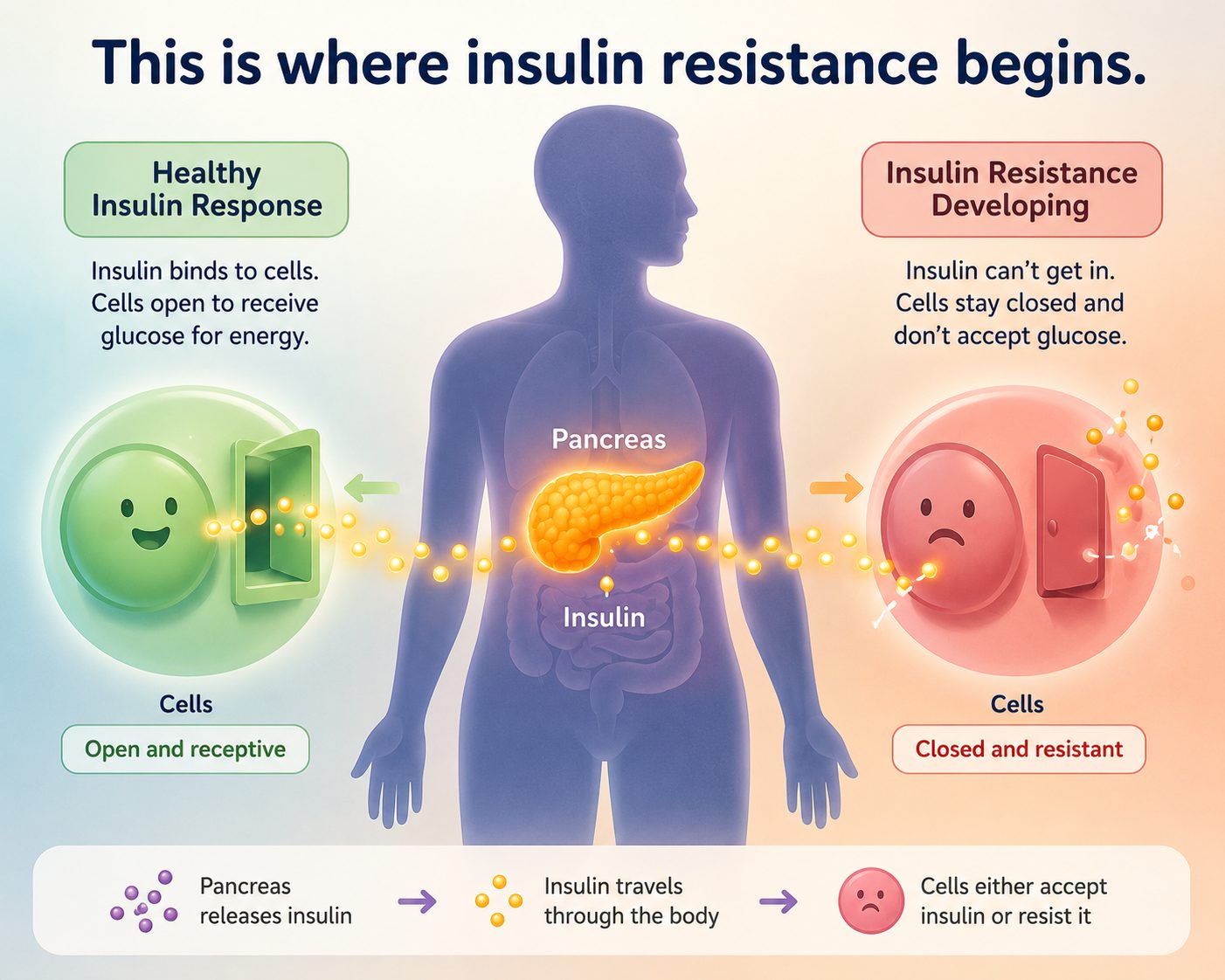
Insulin is a hormone produced by the pancreas, a small gland located near the stomach. Its job is to act like a key that opens the doors of the body's cells so that glucose, which is the sugar from the food your teenager eats, can get inside those cells and be used for energy.
Every time your teenager eats something that contains carbohydrates, whether that is pasta, bread, pizza, fruit, or a bowl of cereal, their blood sugar rises. In response, the pancreas releases insulin to bring that blood sugar back down to a safe level. The insulin essentially escorts the glucose out of the blood and into the cells where it belongs.
Without insulin, that blood sugar would keep climbing to dangerous levels. Insulin is what prevents that from happening. It is not an enemy. It is one of the most important hormones in the body, and it is absolutely necessary for normal metabolism.
How Insulin Resistance in Teens Develops Step by Step
Here is where insulin resistance in teens begins to develop, and this is the part I want you to understand clearly.
When a teenager consistently eats meals and snacks high in refined carbohydrates, their blood sugar spikes repeatedly throughout the day. Every spike triggers a large insulin response. Over time, if this pattern continues and excess weight begins to accumulate, something begins to shift.
The body's cells, surrounded by increasing amounts of body fat, start to become less responsive to insulin's signal. The key still fits the lock, but the lock has become stiff. To get the same result, the pancreas has to produce more and more insulin. Think of it like knocking louder and louder on a door that is harder to open. This is a simplified way to picture it. The real biology involves changes inside the cell itself, including disruptions to the proteins that relay insulin's signal and inflammation that interferes with the process, but the practical result is the same: the body needs more insulin to do the same job.
What Happens When the Pancreas Can No Longer Keep Up
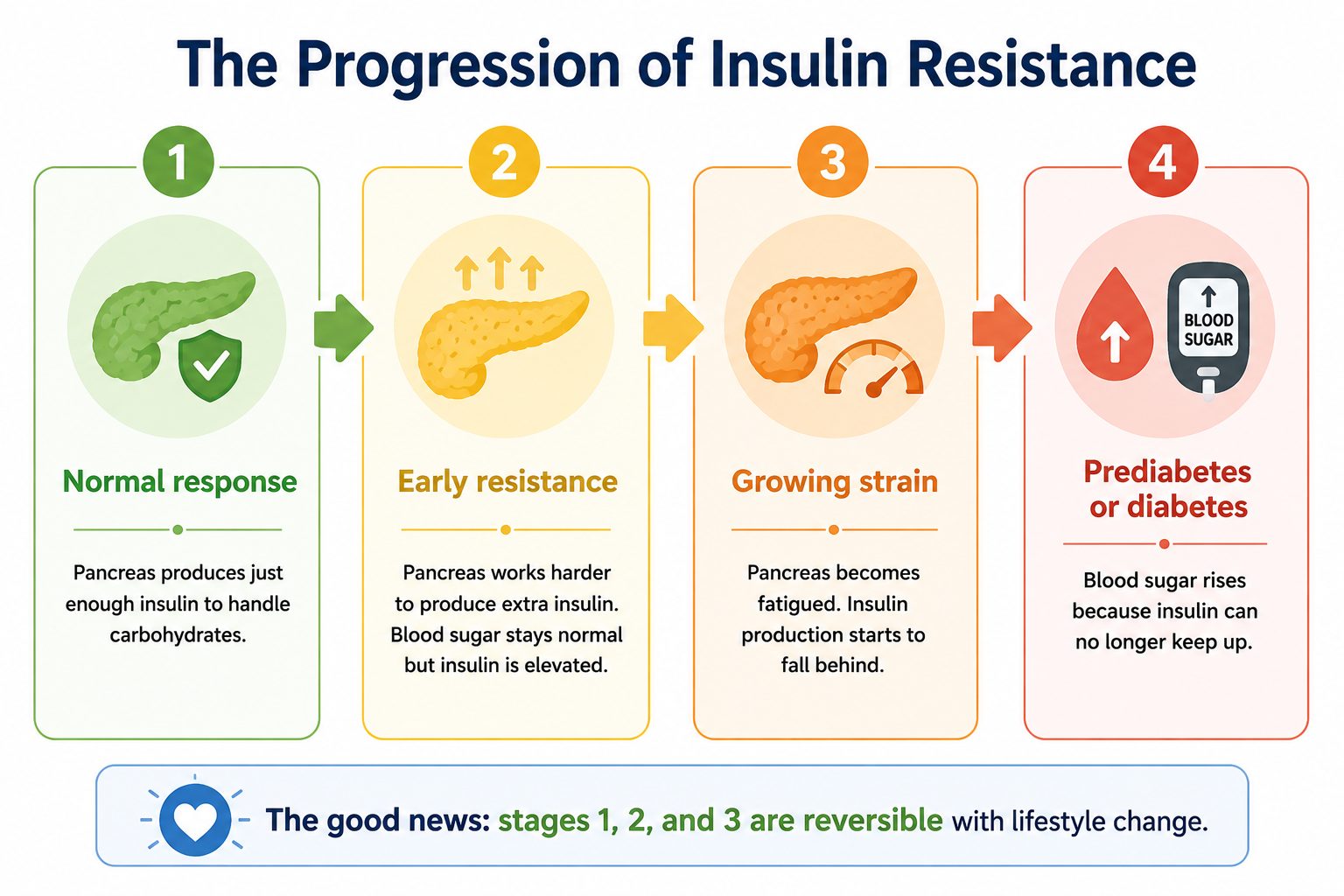
For a while, the pancreas can keep up. It works harder, produces more insulin, and blood sugar stays under control. From the outside, and even on a standard blood test, everything can appear completely normal. But internally, the system is under significant strain.
Eventually, if nothing changes, the pancreas begins to tire. Its ability to produce insulin starts to fall behind the body's demand. That is when blood sugar begins to rise, first into the prediabetes range, and potentially into type 2 diabetes if the progression continues.
The National Institute of Diabetes and Digestive and Kidney Diseases confirms this progression: when cells in the muscles, fat, and liver do not respond properly to insulin, the pancreas produces more to compensate; over time, if the pancreas cannot keep up with the increased demand, blood sugar levels rise into the prediabetes range.
Why Puberty Makes Insulin Resistance in Teens More Complicated
Here is something I want every parent to understand, because it changes the way we should think about this entirely.
Insulin resistance in teens is not only driven by weight. Even a teenager at a completely normal, healthy weight has a degree of insulin resistance during puberty, simply because of the hormones that puberty requires.
During puberty, the body produces high levels of growth hormone to support the physical development that is happening. Growth hormone is essential. It is doing exactly what it is supposed to do. But it also has a significant side effect: it reduces insulin sensitivity by approximately 25 to 30 percent. This means the pancreas of a teenager in puberty already has to work harder than an adult's pancreas to manage the same meal, regardless of their weight.
Why Insulin Resistance in Teens Can Stack From Multiple Directions
Now layer the other contributing factors on top of that. Each one independently adds to the insulin resistance load:
- Excess body weight, particularly around the abdomen, directly reduces how well cells respond to insulin.
- Growth hormone surges during puberty reduce insulin sensitivity by 25 to 30 percent.
- Poor sleep independently worsens insulin resistance. Teenagers who consistently sleep less than the recommended 8 to 10 hours have measurably higher insulin resistance than those who sleep adequately.
- A diet high in refined carbohydrates, without adequate protein or healthy fat, drives repeated large insulin spikes throughout the day.
When an overweight teenager going through puberty is also sleeping poorly and eating mostly processed carbohydrates, all four of these drivers are active at the same time. This is why some teenagers develop prediabetes at surprisingly young ages. By the time they are 16, they may have had a decade of elevated insulin demand on a pancreas that has also been dealing with puberty hormones. The body is young and resilient, but it is not unlimited.
The Craving Connection: Why Insulin Resistance Makes Your Teen Hungrier
This is one of the most important things I explain to teenagers directly, because it immediately takes the blame off them.
One commonly discussed explanation involves blood sugar fluctuations. When a teenager eats something high in refined carbohydrates, their blood sugar rises sharply, the pancreas releases a large amount of insulin to bring it back down, and blood sugar can then dip. Many people experience this dip as renewed hunger or a craving for something sweet shortly after. It is important to say that this exact mechanism is not the only explanation for cravings in teenagers with insulin resistance, and the relationship between blood sugar dips and hunger is more complex than a single cause and effect. But for many teenagers, stabilising blood sugar through balanced meals does appear to reduce the intensity of these cravings, which is a pattern worth paying attention to
This is not weakness or greed. This is a completely predictable hormonal response to a blood sugar roller coaster. The body experienced a drop and it is asking urgently for more fuel to bring the levels back up.
The way to interrupt this cycle is not restriction. It is stabilisation. Meals and snacks that combine protein, healthy fat, and fibre alongside carbohydrates produce a much slower, more gradual blood sugar rise, which triggers a smaller, more proportionate insulin response, which means no dramatic drop, which means no intense craving an hour later.
This is the whole principle behind why food quality matters so much more than food quantity for teenagers with insulin resistance.
For a detailed explanation of why the eat less, move more approach misses this entirely, read my post on why eat less move more fails teenagers with insulin resistance.
9 Warning Signs of Insulin Resistance in Teens
Many families do not know what to look for, and standard blood tests can miss early insulin resistance entirely. Here are the signs that deserve a conversation with your teenager's doctor.
A quick note before this list: some of these signs, like acanthosis nigricans, family history of type 2 diabetes, and abnormal triglyceride or HDL levels, are well-established clinical markers your doctor can act on directly. Others, like fatigue or shakiness, are less specific and can have many causes, but are still worth mentioning to your pediatrician as part of the full picture. It is also worth knowing that directly measuring insulin levels is not generally recommended as a screening tool on its own; doctors typically rely on these established risk factors and targeted testing instead.
- Dark, velvety skin on the back of the neck or in the armpits, called acanthosis nigricans. This is one of the most visible and most commonly missed signs.
- Rapid weight gain, particularly around the belly.
- Persistent fatigue that does not resolve even with adequate sleep.
- Intense sugar and carbohydrate cravings, especially after meals.
- Feeling shaky or dizzy between meals, which can indicate blood sugar fluctuations.
- Irregular or absent periods in teenage girls, which can signal PCOS driven by insulin resistance.
- Acne that does not respond to typical skincare approaches.
- A family history of type 2 diabetes, which significantly increases risk.
- Elevated triglycerides or low HDL cholesterol on a fasting blood panel.
Nemours KidsHealth confirms that insulin resistance can raise a teenager's risk for type 2 diabetes and other health problems, and that doctors recommend maintaining a healthy weight, eating a balanced diet rich in whole grains, fruits, vegetables, and lean protein, and exercising regularly to help improve the body's response to insulin.
What Actually Improves Insulin Resistance in Teens
The good news is that insulin resistance is completely reversible. Lifestyle changes genuinely move the needle, and they do not require perfection. Pick one thing. Start today. Small, consistent changes compound over months into a meaningfully different metabolic picture.
Start With One Change That Addresses Insulin Resistance in Teens Directly
- Focus on nutrient-dense, high-quality foods at meals, including good protein sources, rather than calorie-dense, nutrient-poor options. This general principle, emphasizing food quality over a specific gram target, reflects current ADA guidance for adolescents with insulin resistance. In practice, this often means foods like eggs, yogurt, chicken, fish, beans, and nuts alongside vegetables and whole grains, which tend to be more filling and produce a steadier blood sugar response than refined, processed options. Even adding a hard-boiled egg to breakfast, or chicken to a pasta dish, makes a measurable difference.
- Replace refined carbohydrates with whole food alternatives, one swap at a time. Whole grains, legumes, vegetables, and fruit cause a slower, more gradual blood sugar rise than white bread, chips, or sugary cereals.
- Remove sugary drinks entirely. Sodas, juices, sports drinks, and sweetened coffees deliver large glucose spikes with nothing to slow them down. Replacing them with water is the single highest-impact dietary change most teenagers can make.
- Add a 15 to 20 minute walk after dinner. Even a short post-meal walk measurably reduces the blood sugar spike that follows eating, because muscle activity uses glucose directly and improves insulin sensitivity over time.
- Protect sleep. Teenagers who consistently get 8 to 10 hours of sleep have meaningfully better insulin sensitivity than those who sleep less. Consistent bedtimes and screens out of the bedroom both matter.
These are not dramatic overhauls. They are single, stackable habits. Start with one. Once it feels natural, add another.
For more detail on which specific foods and habits make the biggest difference, my post on prediabetes in teenagers explains what the research supports most strongly.
Your Teenager's Pancreas Can Recover. Start Today.
Insulin resistance in teens is often modifiable, and earlier action gives your teenager the best chance of meaningful improvement. The pancreas of a teenager is young, resilient, and has significant reserves. The earlier a family starts making small, consistent improvements to nutrition, movement, sleep, and stress management, the greater the chance of full reversal before any lasting damage occurs.
This is not your teenager's fault. Their body is navigating puberty hormones, growth demands, and a food environment that was not designed with their biology in mind. They are not lazy or weak; rather, they are dealing with a hormonal system under real pressure.
What they need is the right support, the right information, and one small change to start with today. Your pancreas, and your teenager's, are worth looking after.
No shame. No restriction. Just hormones that work.
If you are not sure whether your teenager's A1C result tells the full story about their metabolic health, read my post on what a normal A1C in teenagers can miss.
For 30 free high-protein recipes designed specifically for teenagers that support blood sugar stability in under 30 minutes, visit lifestyleforteens.com/recipes.
NEXT STEPS
If your teen needs support to build these habits, this is exactly why I created the 100-Day LIFT Program — a pediatric weight management program that does not focus on dieting at all. It addresses the root cause: dysregulated insulin and the hormonal patterns behind the constant hunger, fatigue, and weight gain so many teens are quietly carrying. Over 100 days, we focus on steady blood sugar, protein-forward food, better sleep, calmer stress, and the specific kinds of movement that genuinely improve insulin sensitivity in teenagers.
There is no calorie counting. No food restriction. No shame-based language — because none of that works when the issue is biological, not behavioral.
And this is not an app. Parents and teens get direct, live access to me throughout the program — real conversations, real answers, real support. Not a chatbot. Not a feedback form. A pediatric endocrinologist who knows your teen and is walking the process with you, week by week.
Reach out to learn more, or book a free call with me to see if it is the right fit for your family.
For weekly guidance on teen metabolic health, hormones, and nutrition, I also share something new every week on my Lifestyle and Weight Loss for Teens podcast.
Frequently Asked Questions
What is insulin resistance in teens and why does it matter?
Insulin resistance in teens occurs when the body's cells become less responsive to insulin, the hormone that manages blood sugar. The pancreas compensates by producing more insulin to keep blood sugar under control. Over time, if the pancreas cannot keep up, blood sugar rises into the prediabetes range and eventually type 2 diabetes. It matters because the earlier it is identified and addressed, the more completely it can be reversed.
What causes insulin resistance in teenagers?
The main causes are excess body weight, particularly around the abdomen; the normal hormonal changes of puberty, which reduce insulin sensitivity by approximately 25 to 30 percent even in teenagers at a healthy weight; chronic sleep deprivation; and a diet high in refined carbohydrates without adequate protein or fat. Multiple causes can be active simultaneously, which is why some teenagers develop significant insulin resistance even at relatively young ages.
What are the warning signs of insulin resistance in teens?
Key signs include dark, velvety skin on the back of the neck or in the armpits, rapid weight gain especially around the belly, persistent fatigue, intense sugar and carbohydrate cravings, shakiness between meals, irregular periods in girls, acne, a family history of type 2 diabetes, and elevated triglycerides on a blood test. Many of these signs appear while standard tests like A1C still look completely normal.
Does puberty cause insulin resistance in teenagers?
Yes. Even at a completely healthy weight, every teenager experiences a reduction in insulin sensitivity during puberty of approximately 25 to 30 percent, driven by growth hormone surges. This is normal and necessary for puberty to happen. But it means the pancreas already has to work harder than an adult's during these years. When excess weight, poor sleep, or a high-carbohydrate diet are layered on top of this, the insulin resistance can become clinically significant.
How can I help my teenager improve their insulin resistance?
Start with one change rather than trying to overhaul everything at once. The most impactful first steps are removing sugary drinks and replacing them with water, adding protein to every meal, building 15 to 20 minutes of movement into the day, and protecting sleep consistently. Each of these independently improves insulin sensitivity. Done together over months, they produce a meaningful difference. Working with a pediatric endocrinologist can also help identify how significant the insulin resistance is and whether additional support is needed.
About the Author
Dr. Jenny Gourgari, MD — Pediatric Endocrinologist & Obesity Medicine Specialist
Dr. Jenny is a board-certified Pediatric Endocrinologist and Obesity Medicine Specialist with 15+ years of experience helping teens with insulin resistance and prediabetes. She is the founder of Lifestyle for Teens and creator of the LIFT 100-Day Program. No diets. No shame. Just hormones that work.
Board Certified: Pediatric Endocrinology • Pediatrics • Obesity Medicine (ABOM) • MSc, Georgetown University • Full credentials →






No comment