


6 Critical Things a Normal A1C in Teenagers Can Miss About Metabolic Health

A normal A1C in teenagers is one of the most reassuring things a parent can hear at a doctor's visit. You have been worried. You asked for the test. The result comes back within the normal range, and you breathe a sigh of relief. Your teenager is fine. No diabetes risk. You can stop worrying.
I completely understand that feeling. And I want to gently tell you something important, because I care about your teenager's long-term health.
A normal A1C result does not always mean your teenager's metabolic health is fine. This is one of the biggest misunderstandings I see in families, and it leads to missed opportunities to catch and reverse metabolic problems years before they become serious.
As a pediatric endocrinologist, I see teenagers every week who have normal A1C values but are already showing clear signs of insulin resistance, early hormonal disruption, and the early stages of a metabolic trajectory that can lead to prediabetes if nothing changes.
In this post, I want to explain what A1C actually measures, why it misses important warning signs in teenagers, and what to look for instead. By the end, you will know exactly what questions to ask at your teenager's next appointment.
What Is A1C and What Does It Actually Measure?
Let me start with the basics, because understanding what A1C measures is key to understanding why it has limitations.
A1C stands for hemoglobin A1C, also called glycosylated hemoglobin. Hemoglobin is the protein inside your red blood cells that carries oxygen around the body. When there is glucose (sugar) in the blood, some of that sugar sticks to the hemoglobin. The more sugar in the blood over time, the more sugar attaches to the hemoglobin.
Because red blood cells have a lifespan of approximately three months, the A1C test gives us an average picture of how much sugar has been circulating in the blood over the past three months. It is a three-month average, not a snapshot of today.
An A1C below 5.7% is considered normal. Between 5.7% and 6.4% is the prediabetes range. Above 6.5 %indicates diabetes.
This makes A1C a genuinely useful screening tool. But it is one tool, not the whole picture. And in teenagers specifically, it has significant limitations that most parents are never told about.
Why a Normal A1C in Teenagers Can Miss Early Insulin Resistance
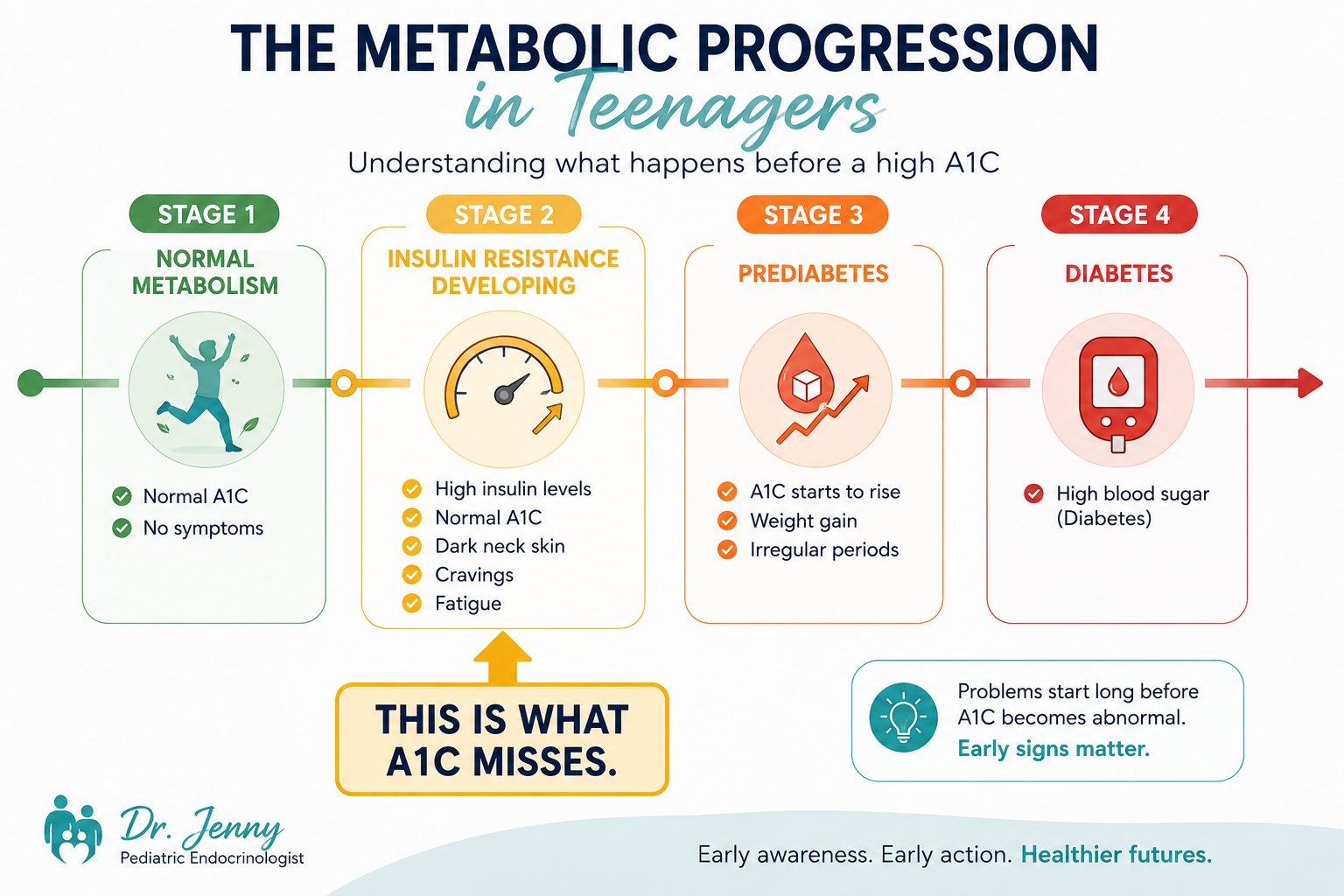
Here is the critical thing to understand about normal A1C in teenagers. A1C is essentially a late marker. It tells us that blood sugar has already been elevated for a sustained period. But insulin resistance, the earliest stage of metabolic disruption, often develops long before blood sugar rises enough to show up in the A1C.
Here is what actually happens in the early stages. When a teenager first develops insulin resistance, their pancreas compensates by producing more and more insulin to keep blood sugar under control. The blood sugar stays normal. The A1C stays normal. Everything looks fine on paper.
But behind that normal A1C result, the pancreas is working two or three times harder than it should. Insulin levels are chronically elevated. The body is under significant metabolic stress. And if nothing changes, this process will eventually tip into prediabetes.
This is what I mean when I say A1C is a late sign. By the time it becomes abnormal, insulin resistance has often been developing for months or even years.
The Pediatric Endocrine Society confirms this in their patient guidance for families: while hemoglobin A1C and fasting glucose are useful screening tools for prediabetes, normal levels can be falsely reassuring, and the oral glucose tolerance test remains the most reliable test for detecting early prediabetes in adolescents.
Why Puberty Makes Normal A1C in Teenagers Even More Misleading
Puberty adds another layer to this picture. During puberty, insulin sensitivity naturally decreases by around 25 to 30 percent. This is driven by the surge of growth hormone that fuels a teenager's physical development. It is a completely normal biological process.
But here is what that means in practice. A teenager who enters puberty already carrying excess weight starts from a position of elevated insulin resistance from the extra fat tissue. Then puberty adds another 25 to 30 percent on top of that. The combined effect can be significant.
Their A1C may still look normal. But their insulin levels, their energy regulation, their hormonal balance, and their risk trajectory are already heading in the wrong direction. And the window to intervene, when change is most effective and most reversible, is right now.
The Warning Signs That Appear Before a Normal A1C in Teenagers Changes
So if we cannot rely on A1C alone to catch early metabolic problems, what should parents and doctors be looking for? Here are the clinical signs that can appear while A1C is still completely normal.
Dark Skin Around the Neck or Armpits
This is called acanthosis nigricans, and it is one of the most visible and underrecognized signs of insulin resistance. It looks like a dark, velvety patch of skin on the back of the neck, in the armpits, or in the skin folds of the abdomen. Many parents assume it is dirt that will not wash off.
It is not dirt. It is the skin's response to chronically elevated insulin levels. And it can appear while A1C is still perfectly normal. If you see this on your teenager, it is a reason to ask for further investigation regardless of what the A1C shows.
I wrote a detailed post explaining what this skin change means and what to do when you see it. It covers exactly how to talk to your doctor about it.
Rapid Weight Gain, Persistent Fatigue, and Sugar Cravings
When insulin resistance is developing, the body struggles to use glucose for energy efficiently. This creates a cycle of fatigue that does not resolve with adequate sleep, cravings for sugar and refined carbohydrates, and weight gain, particularly around the belly.
These symptoms are often dismissed as normal teenage behaviour. Too much screen time, not enough sleep, typical adolescent eating habits. But when they cluster together, especially alongside other risk factors, they deserve a closer look.
Irregular Periods and Acne in Teenage Girls
For teenage girls, polycystic ovary syndrome (PCOS/new name PMOS) is closely connected to insulin resistance. PMOS affects around 10 percent of females of reproductive age and is one of the most common hormonal conditions in teenage girls. Signs include irregular or missed periods, acne, and sometimes excess hair growth.
Insulin resistance drives the hormonal imbalances behind PMOS. And just like the other signs I have mentioned, PMOS can be present while A1C is entirely within the normal range.
Family History of Type 2 Diabetes
Genetics matters. If a teenager has a parent, grandparent, or close family member with type 2 diabetes, their baseline risk is higher than the general population. This family history, combined with any of the other signs above, is a strong reason to request additional metabolic screening rather than stopping at A1C.
Fatty Liver Disease
Non-alcoholic fatty liver disease in teenagers is strongly associated with insulin resistance and is another condition that can develop while A1C remains normal. If your teenager has been found to have elevated liver enzymes or fatty liver on an ultrasound, this is a metabolic signal that deserves investigation.
What Additional Tests a Pediatric Endocrinologist May Recommend
When a pediatric endocrinologist has a high clinical suspicion of insulin resistance, even with a normal A1C, there are additional investigations that can provide a more complete picture.
Fasting Glucose
A fasting blood glucose test measures blood sugar after the patient has not eaten for at least eight hours. Normal is below 100 mg/dL. The prediabetes range is 100 to 125 mg/dL. This test can sometimes catch early blood sugar elevation that A1C misses, particularly in teenagers whose red blood cell lifespan may affect how accurately A1C reflects their true average glucose.
Oral Glucose Tolerance Test (OGTT)
This is the most sensitive test for detecting early glucose dysregulation in teenagers. The patient drinks a measured solution containing 75 grams of glucose. Blood sugar measurements are taken at two hours afterward. A two-hour reading between 140 and 199 mg/dL indicates prediabetes. Above 200 indicates diabetes.
The National Institute of Diabetes and Digestive and Kidney Diseases (NIDDK) confirms that the oral glucose tolerance test can identify how the body handles glucose after a meal, often before fasting blood glucose becomes abnormal, making it a valuable tool for catching early metabolic problems that A1C can miss.
The test requires a couple of hours and is not the most comfortable experience, but in high-risk cases it provides information that no other test can.
Fasting Lipid Profile: Triglycerides and HDL Cholesterol
A fasting lipid profile measures cholesterol levels and triglycerides. HDL is the protective “good cholesterol”, and LDL is the type associated with cardiovascular risk ie “bad cholesterol”. In the context of insulin resistance, what we watch closely is the combination of elevated triglycerides alongside low HDL cholesterol.
This pattern is not diagnostic of prediabetes on its own, but it is a meaningful clue. When a doctor sees a teenager with high triglycerides, low HDL, dark neck skin, and a normal A1C, that combination paints a much clearer picture of metabolic risk than the A1C alone.
What This Means for You as a Parent
I want to be clear about something. I am not telling you this to create anxiety. A normal A1C result in a healthy-weight teenager with no symptoms and no family history is genuinely reassuring.
What I am saying is that for teenagers who carry excess weight, who are showing physical signs of insulin resistance, who have a family history of type 2 diabetes, or who have PCOS or fatty liver disease, a normal A1C is not the full story. It is one piece of a more complex picture.
According to a 2023 CDC report, about 1 in 3 American adolescents aged 12 to 17 currently have prediabetes. Most of them have no idea.
The most important thing you can do is ask the right questions at your teenager's next appointment. Do not just ask what the A1C result is. Ask whether your teenager's full metabolic picture has been assessed, including their weight trajectory, physical signs of insulin resistance, family history, and whether additional testing is appropriate.
If your teenager has already been diagnosed with prediabetes, I have a detailed post walking through exactly what the research says about reversing it through lifestyle change.
What You Can Do Today to Support Your Teenager's Metabolic Health
Whether your teenager has a completely normal A1C or is already showing early warning signs, the lifestyle changes that protect metabolic health are the same. And none of them require a diagnosis first.
- Remove sugary drinks from the household such as sodas, juice, sports drinks, and sweetened coffees . This simple dietary change can significantly reduce insulin spikes. Replace them with water.
- Add protein to every meal. Protein blunts the blood sugar spike that follows carbohydrates and keeps your teenager fuller for longer. Aim for at least 20-30 grams at breakfast, lunch, and dinner, although many teens require more than that.
- Prioritise daily movement. Even a 20-minute walk after dinner reduces post-meal blood sugar meaningfully. Any movement counts, every single day.
- Protect sleep. Teenagers need 8 to 10 hours of sleep every night. Chronic sleep deprivation directly worsens insulin resistance. Consistent bedtimes and screens out of the bedroom make a real difference.
- Reduce processed carbohydrates. Chips, crackers, white bread, sugary cereals, and fast food drive repeated insulin spikes. Replace them gradually with whole food alternatives.
These five changes, done consistently over months, can meaningfully improve insulin sensitivity, reduce metabolic risk, and support your teenager's health regardless of what their A1C currently shows.
For specific meal ideas to support this, I have put together 30 free high-protein recipes designed specifically for teenagers. They take under 30 minutes and are genuinely teenager-friendly.
A Normal A1C Is a Starting Point, Not a Final Answer
The biggest takeaway I want you to carry from this post is simple. A normal A1C in teenagers does not always mean their metabolic health is fine, especially during puberty and especially for teenagers who have risk factors for diabetes.
If your teenager has a normal A1C but also has dark neck skin, persistent fatigue, rapid weight gain, irregular periods, a family history of diabetes, fatty liver, or PCOS, please do not stop at the A1C. Ask for a fuller assessment. Ask about fasting glucose, a fasting lipid profile, and whether an oral glucose tolerance test is appropriate.
You are not being difficult. You are being informed. And that is exactly the kind of parent advocacy that catches metabolic problems early, when they are most reversible.
If your teen needs support to build these healthy habits, I created the 100 days LIFT program. The program addresses the root cause: dysregulated insulin and the hormonal patterns that drive constant hunger, fatigue, and weight gain in adolescents. The 100-day curriculum focuses on stable blood sugar, protein-forward nutrition, sleep quality, stress regulation, and the specific types of movement that genuinely improve insulin sensitivity in teenagers.
There is no calorie counting, no food restriction, and no shame-based language — because those approaches do not work when the problem is biological, not behavioral.
This is not an app experience. Parents and teens have direct, live access to Dr. Jenny throughout the program — real conversations, real answers, real support. Not a chatbot. Not a feedback form. A pediatric endocrinologist who knows your teen's case and is actively guiding the process week by week.
Reach out to me to learn more about the program.
For weekly guidance on teen metabolic health, hormones, and nutrition, I also share new information every week on my Lifestyle and Weight Loss for Teens podcast.
Common Questions
What is a normal A1C for a teenager?
Can a teenager have insulin resistance with a normal A1C?
What tests should I ask for if my teenager has a normal A1C but shows signs of insulin resistance?
How can I improve my teenager's metabolic health if their A1C is currently normal?
About the Author
Dr. Jenny Gourgari, MD — Pediatric Endocrinologist & Obesity Medicine Specialist
Dr. Jenny is a board-certified Pediatric Endocrinologist and Obesity Medicine Specialist with 15+ years of experience helping teens with insulin resistance and prediabetes. She is the founder of Lifestyle for Teens and creator of the LIFT 100-Day Program. No diets. No shame. Just hormones that work.
Board Certified: Pediatric Endocrinology • Pediatrics • Obesity Medicine (ABOM) • MSc, Georgetown University • Full credentials →






No comment