


How Much Weight Should My Teenager Lose? 4 Simple Steps to Find Out

How much weight should my teenager lose to reach a healthy weight? This is one of the questions I get asked most often by parents, and I understand exactly why it feels confusing. There is no simple chart that tells you a specific pound amount for a specific age, the way there might be for an adult. Teenagers are still growing, their bodies are changing constantly, and the answer depends on more than just a number on a scale.
I have thought a lot about the easiest way to walk families through this question, and I want to give you the exact tool I use, broken down step by step, so you can do this at home today.
This is not about putting pressure on your teenager or making them feel like a project. It is about understanding where things stand right now, with real information, so you can have an informed conversation with their pediatrician about what comes next.
Understanding BMI Percentile: The Tool Behind How Much Weight Should My Teenager Lose
Before we can answer the question, we need to understand body mass index, or BMI. You are going to hear me reference this tool again and again, because it is the measure scientists use repeatedly when researching pediatric weight and whether a particular method actually works.
Here is why we use BMI rather than a simple weight number. Children and teenagers are different heights and weights at different ages, so a flat number like 130 pounds means something completely different for a 10-year-old than it does for a 16-year-old. BMI accounts for that by combining a person's height and weight into one calculation, which is then compared to a growth chart specific to their age and sex.
The formula itself is simple: weight in kilograms divided by height in meters squared. But you do not need to do this calculation by hand. The easiest and most reliable source is the CDC's official Child and Teen BMI Calculator.
The CDC's Child and Teen BMI Calculator allows you to enter your child's age, sex, height, and weight, and instantly calculates their BMI percentile based on data specific to their age and sex.
What the BMI Percentile Categories Actually Mean
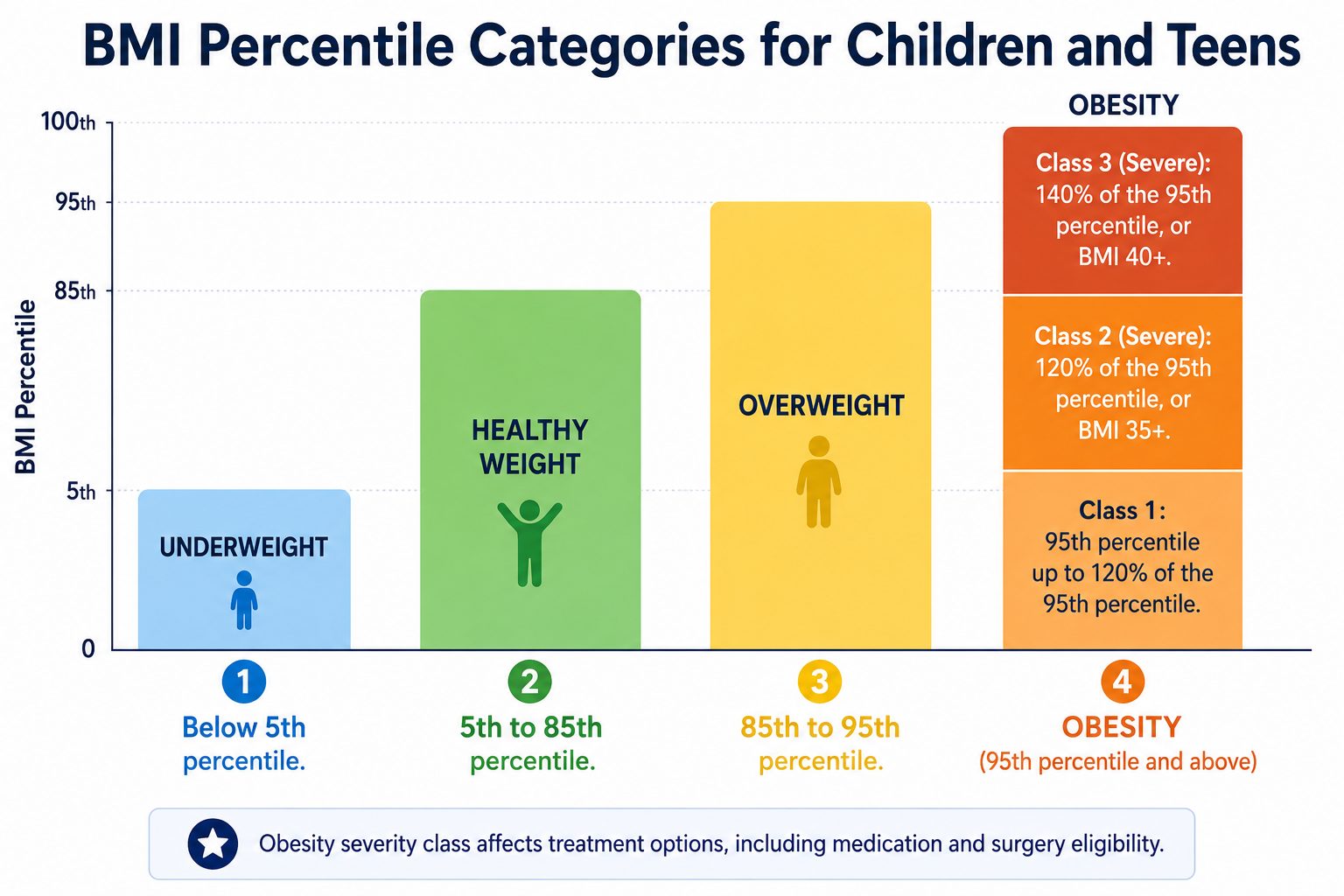
Once you enter your teenager's information into the calculator, you will get a BMI percentile. Here is how the CDC defines each category:
- Underweight: BMI below the 5th percentile for age and sex
- Healthy weight: BMI at or above the 5th percentile and below the 85th percentile
- Overweight: BMI at or above the 85th percentile and below the 95th percentile
- Obesity: BMI at or above the 95th percentile
These exact percentile thresholds are confirmed by the CDC's official BMI guidance, which defines obesity in children and teens as a BMI at or above the 95th percentile for sex and age.
What “How Much Weight Should My Teenager Lose” Actually Means in Clinical Practice
I want to gently push back on the way this question gets asked, because the honest clinical answer is different from what most parents expect.
The American Academy of Pediatrics does not recommend calculating a specific pound target at home. In fact, for most teenagers with obesity who do not have additional health complications, the actual goal is not weight loss at all. It is weight maintenance, allowing your teenager's BMI percentile to gradually decline naturally as they grow taller. Height increases while weight stays steady, and the BMI number comes down on its own over time.
For teenagers who do have obesity-related health complications, such as prediabetes, high blood pressure, or fatty liver, the guideline supports gradual weight loss, but capped at no more than 2 pounds per week. There is no single pound number a parent is meant to land on by trial and error.
The Endocrine Society frames meaningful clinical improvement a little differently, describing a BMI decrease of about 1.5 kg/m² as significant, or around 7 percent of body weight for adolescents with severe obesity. Again, this comes from a clinician evaluating your teenager directly, not a number calculated at home.
So if you came here looking for “the number,” I want to be honest with you: the better and safer question is not how many pounds, but what is the right pace and the right kind of support for my teenager, given where they are right now.
Why BMI Percentile Categories Now Include Obesity Severity Classes
Since 2022, the CDC and AAP also break the obesity category down further, because treatment intensity depends on how severe it is:
- Class 1 obesity: BMI at or above the 95th percentile, up to 120% of the 95th percentile
- Class 2, severe obesity: BMI at or above 120% of the 95th percentile, or a BMI of 35 or higher
- Class 3, severe obesity: BMI at or above 140% of the 95th percentile, or a BMI of 40 or higher
This matters because higher severity classes are when conversations about medication or, in some cases, metabolic and bariatric surgery become part of the picture, alongside lifestyle support, not instead of it.
Why BMI Is a Good Tool, But Not the Whole Story
I want to address something I hear often, because it is a fair point. A lot of people are skeptical of BMI because it can overestimate body fat in people who exercise heavily, particularly athletes and people with significant muscle mass. That is true, and it is a real limitation.
However, in the majority of teenagers and children who fall into the overweight or obesity category, the percentage of body fat tends to track closely with the BMI percentile. There are more precise methods for measuring body fat directly, but BMI remains the most widely used tool in pediatric research because it only requires height, weight, and sex, making it accessible, consistent, and easy to track over time.
Looking at BMI does not mean we only focus on weight as a number. It is not the single best or most comprehensive measure of a teenager's overall health. But it is a genuinely useful tool, and the most practical one available, for tracking progress over time and for identifying when a closer conversation with a pediatrician is worthwhile.
What Real Treatment Looks Like, According to the AAP
The AAP's 2023 guideline is specific about what actually works, and it is more structured than “eat better and move more.” The cornerstone of treatment is something called Intensive Health Behavior and Lifestyle Treatment, or IHBLT. This means at least 26 hours of face-to-face, family-based support over 3 to 12 months, covering nutrition, physical activity, and behavior change together, not delivered in a single appointment.
For teenagers 12 and older with obesity, medication can be added alongside this lifestyle support when appropriate. For adolescents 13 and older with severe obesity, metabolic and bariatric surgery is also a recognized, evidence-based option, always provided together with ongoing lifestyle treatment, not as a replacement for it.
I share this because I do not want to undersell what real, effective treatment involves. Small, consistent habits genuinely matter and are part of every plan I build with families. But they work best as part of a structured, supported program, not as a stand-alone fix taken on without guidance.
The AAP also specifically recommends screening for disordered eating as part of any obesity evaluation. This is an important and often overlooked step, and one reason why working with your pediatrician directly, rather than self-directing a weight goal at home, is genuinely the safer path.
NEXT STEPS
If your teen needs support to build these habits, this is exactly why I created the 100-Day LIFT Program — a pediatric weight management program that does not focus on dieting at all. It addresses the root cause: dysregulated insulin and the hormonal patterns behind the constant hunger, fatigue, and weight gain so many teens are quietly carrying. Over 100 days, we focus on steady blood sugar, protein-forward food, better sleep, calmer stress, and the specific kinds of movement that genuinely improve insulin sensitivity in teenagers.
There is no calorie counting. No food restriction. No shame-based language — because none of that works when the issue is biological, not behavioral.
And this is not an app. Parents and teens get direct, live access to me throughout the program — real conversations, real answers, real support. Not a chatbot. Not a feedback form. A pediatric endocrinologist who knows your teen and is walking the process with you, week by week.
Reach out to learn more, or book a free call with me to see if it is the right fit for your family.
For weekly guidance on teen metabolic health, hormones, and nutrition, I also share something new every week on my Lifestyle and Weight Loss for Teens podcast.
Frequently Asked Questions
How much weight should my teenager lose to be at a healthy weight?
The exact answer to how much weight should my teenager lose depends on their current height, age, sex, and BMI percentile. The CDC's Child and Teen BMI Calculator can help you find this by entering your teenager's information and noting their current BMI percentile, then testing lower weights at the same height until you reach the 85th percentile, which marks the top of the healthy weight range. Always confirm the specific number with your teenager's pediatrician, who can also factor in their expected growth.
What BMI percentile is considered healthy for a teenager?
According to the CDC, a healthy weight for a teenager is a BMI at or above the 5th percentile and below the 85th percentile for their age and sex. Below the 5th percentile is classified as underweight. Between the 85th and 95th percentile is considered overweight. At or above the 95th percentile is classified as obesity.
Does a teenager's healthy weight change as they grow?
Yes, significantly. Because teenagers continue to grow in height, their healthy weight range shifts upward as they age. A teenager who falls in the overweight category today may move into the healthy range a year or two later simply because they grew taller, as long as they do not gain further excess weight in the meantime. This is why tracking BMI percentile as a trend over time, rather than focusing on one single measurement, gives a more accurate picture.
How do I calculate my teenager's BMI without doing the math myself?
The simplest and most reliable way is to use the CDC's official Child and Teen BMI Calculator, which only requires your teenager's age, sex, height, and weight. It calculates the BMI automatically and shows you the corresponding percentile for their age and sex, removing the need for manual calculation.
My teenager is in the obesity BMI category. What should I do next?
The most helpful next step is a conversation with your teenager's pediatrician to discuss the number in context and rule out or identify any underlying factors such as insulin resistance. From there, focus on improving food quality, building enjoyable daily movement, protecting sleep, and managing stress rather than restrictive dieting, which research shows is not effective or safe for teenagers. Small, consistent changes made with the whole family tend to produce the most lasting results.
About the Author
Dr. Jenny Gourgari, MD — Pediatric Endocrinologist & Obesity Medicine Specialist
Dr. Jenny is a board-certified Pediatric Endocrinologist and Obesity Medicine Specialist with 15+ years of experience helping teens with insulin resistance and prediabetes. She is the founder of Lifestyle for Teens and creator of the LIFT 100-Day Program. No diets. No shame. Just hormones that work.
Board Certified: Pediatric Endocrinology • Pediatrics • Obesity Medicine (ABOM) • MSc, Georgetown University • Full credentials →






No comment