


Weight Loss and PCOS in Teenagers: 7 Proven Findings From a Penn State Study
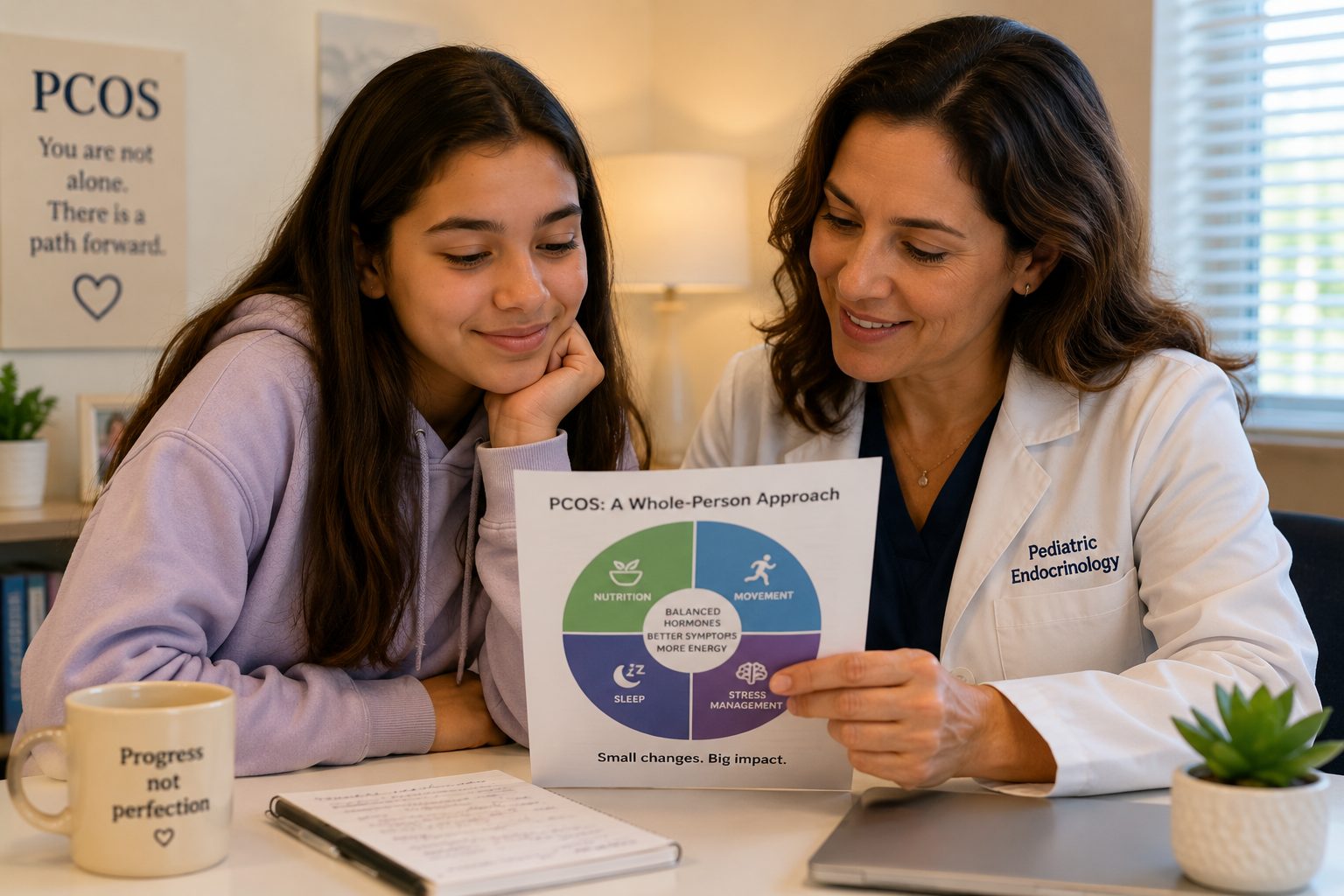
Weight loss and PCOS in teenagers are connected in a way that I think more families deserve to understand clearly. If your teenage daughter has polycystic ovary syndrome, you have probably already heard about metformin, the medication commonly prescribed to help improve irregular periods. It works by improving insulin resistance, which is the underlying driver of most PCOS symptoms in teenagers.
But medication is not the only path. There are natural ways to improve insulin resistance, and this applies just as much to teenage girls with PCOS as it does to any other teenager working on their metabolic health.
I want to walk you through a study that demonstrates this beautifully. It is a small study, but the findings are genuinely meaningful, and I think every family navigating a PCOS diagnosis should hear about it.
What the Weight Loss and PCOS in Teenagers Study Actually Found
The study, titled Effect of Weight Loss on Menstrual Function in Adolescents with Polycystic Ovary Syndrome, was conducted at Penn State Hershey Children's Hospital in Pennsylvania. The lead author was Dr. Rollyn M. Ornstein.
Researchers enrolled 24 girls between the ages of 12 and 22 who had a diagnosis of PCOS and a BMI above the 85th percentile for their age, meaning they were classified as overweight or had obesity. While the study is commonly referenced in the context of adolescent PCOS, it is worth noting that participants ranged up to age 22, meaning some were young adults rather than strictly teenagers. The findings are still highly relevant for the teenage years, but the results reflect a mixed adolescent and young adult group.
All of the participants had fewer than six spontaneous menstrual cycles in the year before the study began, which reflects how significant their menstrual irregularity was.
The full study, published in the Journal of Pediatric and Adolescent Gynecology in 2011, describes a 12-week randomized pilot trial comparing two different dietary approaches in this group of teenage girls with PCOS.
The Two Diets Tested in This Weight Loss and PCOS in Teenagers Study
Participants were divided into two groups, each following a different dietary plan for 12 weeks.
The first group followed a low-fat diet, limited to no more than 40 grams of fat per day, with five servings of starch daily, where one serving equaled 15 grams of carbohydrates. They could eat unlimited fat-free dairy, fruits, and vegetables.
The second group followed a low-carbohydrate diet, starting at just 20 grams of carbohydrates per day for the first two weeks, with unlimited fat and protein. From weeks three through twelve, carbohydrates increased slightly to 40 grams per day, with the addition of low glycemic index foods like nuts, fruit, and whole grains, meaning foods that do not cause a large spike in insulin.
Both groups met with a dietitian every two weeks for guidance and accountability, were asked to drink at least 50 ounces of water daily, and received multivitamins along with extra fibre if needed.
The Results: How Weight Loss and PCOS in Teenagers Are Connected
Of the 24 girls who enrolled, only 16 completed the full 12-week study, meaning 8 participants, or 33 percent, did not finish. This is a meaningful dropout rate and worth keeping in mind when interpreting the results. It tells us that following a structured dietary program for 12 weeks is genuinely challenging, and that the girls who did complete the study may have been more motivated or better supported than those who did not. The results are encouraging, but they reflect completers rather than all participants
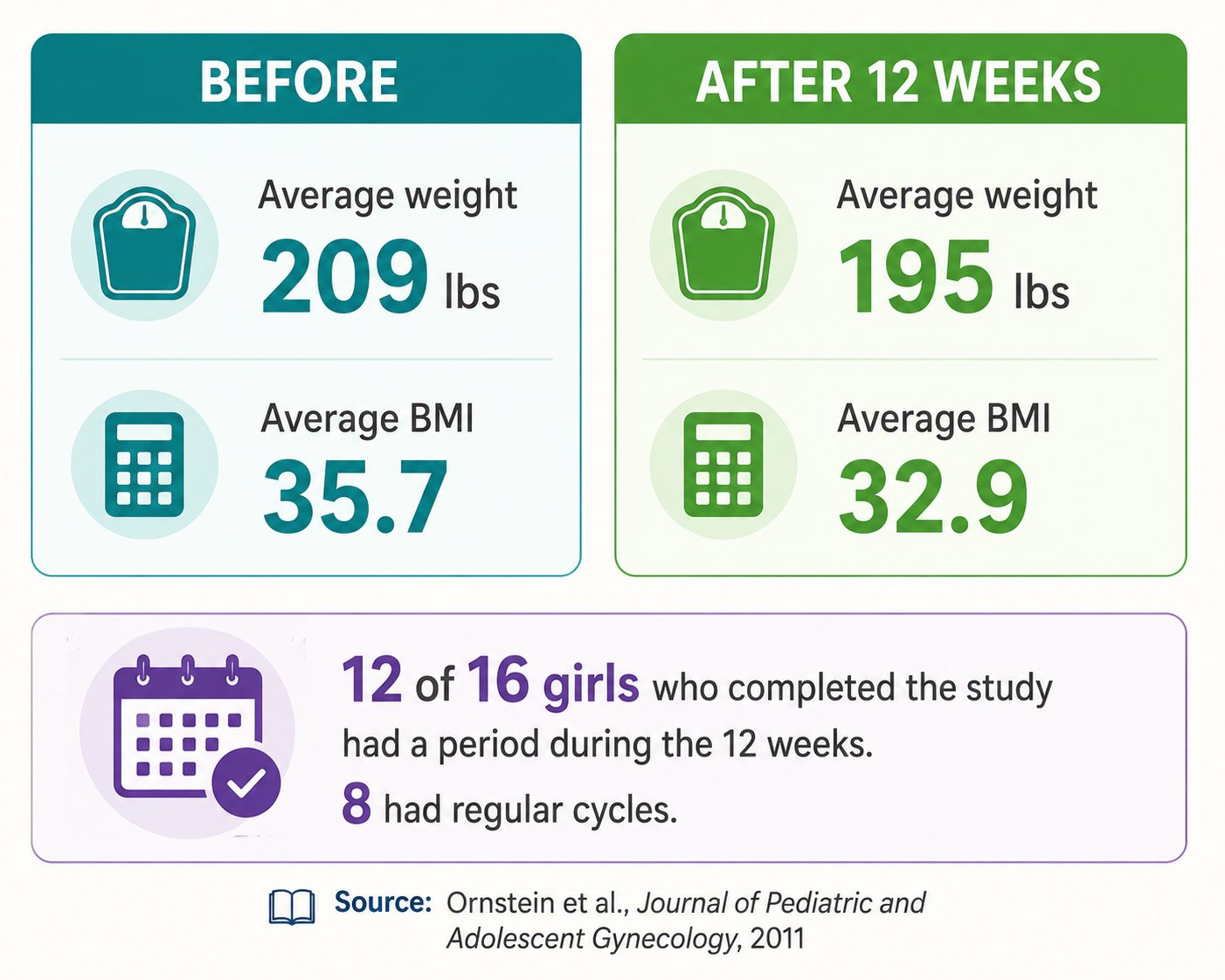
Both groups, whether they followed the low-carbohydrate plan or the low-fat plan, showed significant improvements in weight, insulin resistance, and belly fat. As a group, participants lost an average of 6.5 percent of their body weight. They started at an average weight of 209 pounds, give or take 41 pounds, and ended the study at an average of 195 pounds, give or take 39 pounds. Average BMI dropped from 35.7 to 32.9.
And here is the most striking part. Of the 16 girls who completed the study, 12 menstruated during the 12-week period, and 8 of those had cycles that were considered regular. For teenagers who had been experiencing fewer than six periods a year before the study, this is a meaningful and genuinely hopeful improvement, achieved through a structured dietary program with no medication. It is worth noting that both groups received active dietary counseling and regular check-ins throughout the study, so the improvements reflect the combination of dietary change and structured support rather than diet alone. There was no no-intervention control group, which means we cannot fully separate the effect of the specific diet from the general benefit of consistent guidance and accountability.
3 Reasons This Study Matters So Much for Teenage Girls With PCOS
Reason 1: A Healthier Weight Is Genuinely Possible
If you are a parent of a teenage girl with PCOS, it is easy to feel like the syndrome itself makes weight loss impossible. This study shows clearly that it does not. With consistent dietary support over just 12 weeks, meaningful weight loss happened. PCOS is a syndrome, not a life sentence, and it is not something that cannot be influenced by lifestyle change.
Reason 2: You Do Not Need to Reach a ‘Perfect' Weight to See Real Benefits
This is one of the most encouraging parts of the findings. The girls in this study lost an average of 6.5 percent of their body weight. That is not full weight normalization. It is a percentage. And research consistently shows that even a 5 percent reduction in body weight can produce significant improvement in insulin resistance, often enough to restore menstrual cycles without any medication.
This matters because it removes the pressure of an all-or-nothing goal. Partial progress is not a failure. It is exactly the kind of progress that produces real hormonal change.
Reason 3: The Specific Diet Mattered Less Than Consistency
Both the low-carbohydrate group and the low-fat group saw meaningful improvements. Neither diet was clearly superior to the other for weight loss or menstrual improvement in this study. What mattered was that participants were consistent with whichever approach they were following, and that they had structured, regular support from a dietitian every two weeks.
As fat distribution and overall weight improved in both groups, insulin resistance improved, regardless of which specific diet got them there. This is genuinely good news, because it means there is no single rigid diet your teenage daughter must follow. What matters is finding an approach she can stick with consistently, supported by guidance along the way.
One important consideration I want to be transparent about, particularly for families of teenage girls with PCOS: adolescents with PCOS carry a significantly higher risk of disordered eating than their peers, with some research suggesting the risk may be up to four times higher. This means any dietary approach pursued alongside a PCOS diagnosis should be monitored carefully by a clinician, with attention to how your daughter is relating to food, her body, and mealtimes. This is not a reason to avoid lifestyle change. It is a reason to pursue it with proper professional support rather than self-directed restriction at home
To understand more about how insulin resistance develops and why it plays such a central role in PCOS, read my post on insulin resistance in teens.
Understanding the PCOS and Insulin Resistance Connection
I want to take a moment to explain why this works, because understanding the biology makes the whole picture clearer.
Insulin resistance is part of the underlying biology of PCOS for most teenage girls who have it. When the body becomes resistant to insulin, the pancreas compensates by producing more of it. Elevated insulin levels then drive the ovaries to produce more androgens, which are male hormones that, in excess, disrupt ovulation and lead to irregular or absent periods. This same elevated insulin also makes it easier for the body to store fat, particularly around the belly.
This creates a cycle. Insulin resistance contributes to weight gain. Weight gain, particularly around the abdomen, worsens insulin resistance. And worsening insulin resistance disrupts periods further. The encouraging part is that this cycle works in reverse too. Improving insulin resistance, through weight management, nutrition, movement, and sleep, can restore more regular ovulation and periods, exactly as this study demonstrated.
The Office on Women's Health confirms that insulin resistance is present in many people with PCOS and that lifestyle changes, including weight management, are considered an important first-line approach for improving symptoms, including irregular periods.
PCOS often comes with other visible signs of insulin resistance too, including dark, velvety skin around the neck. My post on dark neck skin in teenagers explains what this means and why it matters.
What This Means for Your Teenage Daughter
If your daughter has PCOS, I want you to take three things away from this study, because I think they genuinely reframe what is possible.
- Lifestyle change is not a consolation prize. It produced measurable, meaningful improvements in weight, insulin resistance, and menstrual regularity in just 12 weeks without medication.
- You do not need to choose a single perfect diet. Both approaches worked because both supported consistent calorie awareness, regular check-ins, and a focus on real food.
- This can work alongside medication too, not only instead of it. If your daughter is already taking metformin, improving her nutrition and activity levels can enhance the medication's effectiveness rather than compete with it.
None of this is about restriction or pressure. It is about building sustainable habits with real support, the same approach that produced these results in just three months.
Don't Let a PCOS Diagnosis Feel Like the End of the Story
The relationship between weight loss and PCOS in teenagers is genuinely hopeful when you look at the actual research. PCOS is a syndrome, but it is not unchangeable. Teenage girls can and do see their periods return to a more regular rhythm by improving insulin resistance, exactly as this study showed.
There are other aspects of PCOS that may need separate attention, including elevated testosterone, acne, and excess hair growth, and your pediatric endocrinologist is the right person to guide treatment for those specific concerns. But when it comes to weight and metabolic health, the message from this research is clear and encouraging: small, consistent changes, supported properly, can produce real, measurable results.
This is not medical advice, and I always recommend speaking with your daughter's pediatrician or pediatric endocrinologist about her specific situation. But I hope this study gives you, and her, genuine hope that progress is possible.
If you want to know where your daughter's current weight stands relative to a healthy range for her age, my post on how much weight should my teenager lose walks through exactly how to think about that using the same tools researchers use.
NEXT STEPS
If your teen needs support to build these habits, this is exactly why I created the 100-Day LIFT Program — a pediatric weight management program that does not focus on dieting at all. It addresses the root cause: dysregulated insulin and the hormonal patterns behind the constant hunger, fatigue, and weight gain so many teens are quietly carrying. Over 100 days, we focus on steady blood sugar, protein-forward food, better sleep, calmer stress, and the specific kinds of movement that genuinely improve insulin sensitivity in teenagers.
There is no calorie counting. No food restriction. No shame-based language — because none of that works when the issue is biological, not behavioral.
And this is not an app. Parents and teens get direct, live access to me throughout the program — real conversations, real answers, real support. Not a chatbot. Not a feedback form. A pediatric endocrinologist who knows your teen and is walking the process with you, week by week.
Reach out to learn more, or book a free call with me to see if it is the right fit for your family.
For weekly guidance on teen metabolic health, hormones, and nutrition, I also share something new every week on my Lifestyle and Weight Loss for Teens podcast.
Frequently Asked Questions
Can weight loss improve PCOS symptoms in teenagers?
Yes. A study from Penn State Hershey Children's Hospital found that weight loss and PCOS in teenagers are closely connected. In a 12-week trial, teenage girls with PCOS who followed either a low-carbohydrate or low-fat diet lost an average of 6.5 percent of their body weight and saw significant improvements in insulin resistance, belly fat, and menstrual regularity, all without medication.
How much weight does a teenager with PCOS need to lose to see improvement?
Research suggests that even a modest weight loss of around 5 percent of current body weight can produce a meaningful improvement in insulin resistance, which is often enough to help restore more regular menstrual cycles. In the Penn State study, participants lost an average of 6.5 percent and saw significant improvement, showing that full weight normalization is not required to see real benefits.
Is a low-carb or low-fat diet better for teenage girls with PCOS?
According to the Penn State study, neither diet was clearly superior. Both the low-carbohydrate group and the low-fat group showed significant improvements in weight, insulin resistance, and menstrual function. What mattered most was staying consistent with one approach and getting regular support from a dietitian, not which specific diet the girls followed
Why does insulin resistance affect periods in girls with PCOS?
Elevated insulin levels, which occur when the body becomes resistant to insulin, drive the ovaries to produce excess androgens. These elevated androgens disrupt normal ovulation, leading to irregular or absent periods. Improving insulin resistance through weight management, nutrition, and movement can help restore more regular ovulation and menstrual cycles.
Can lifestyle changes work alongside metformin for teen PCOS?
Yes. Lifestyle changes such as improved nutrition, regular movement, and better sleep can enhance the effectiveness of metformin rather than compete with it. If your teenage daughter is already taking metformin for PCOS, adding consistent lifestyle habits can help maximise the benefit of the medication.
What other symptoms of PCOS does weight management not address?
While improving insulin resistance through weight management can help with menstrual regularity and metabolic health, other PCOS-related symptoms such as elevated testosterone, acne, and excess hair growth (hirsutism) often require separate, targeted treatment. A pediatric endocrinologist can help determine the right combination of approaches for your daughter's specific symptoms.
About the Author
Dr. Jenny Gourgari, MD — Pediatric Endocrinologist & Obesity Medicine Specialist
Dr. Jenny is a board-certified Pediatric Endocrinologist and Obesity Medicine Specialist with 15+ years of experience helping teens with insulin resistance and prediabetes. She is the founder of Lifestyle for Teens and creator of the LIFT 100-Day Program. No diets. No shame. Just hormones that work.
Board Certified: Pediatric Endocrinology • Pediatrics • Obesity Medicine (ABOM) • MSc, Georgetown University • Full credentials →





No comment