


How to Stay Motivated to Lose Weight as a Teenager: 17 Proven Reasons

How to stay motivated to lose weight as a teenager is a question I hear constantly, and it tends to follow a very predictable pattern. The new year starts. Motivation is high. The gym is full. Everyone is talking about getting healthier. And then a few months pass, life gets busy, and that motivation quietly fades.
This is not a character flaw. It is one of the most universal experiences in human behavior change, and teenagers are certainly not immune to it. So I want to talk today about what actually motivates teenagers to want a healthier weight in the first place, and then walk through specific, doable strategies that help that motivation last well beyond January.
The 17 Motivations Behind How to Stay Motivated to Lose Weight as a Teenager
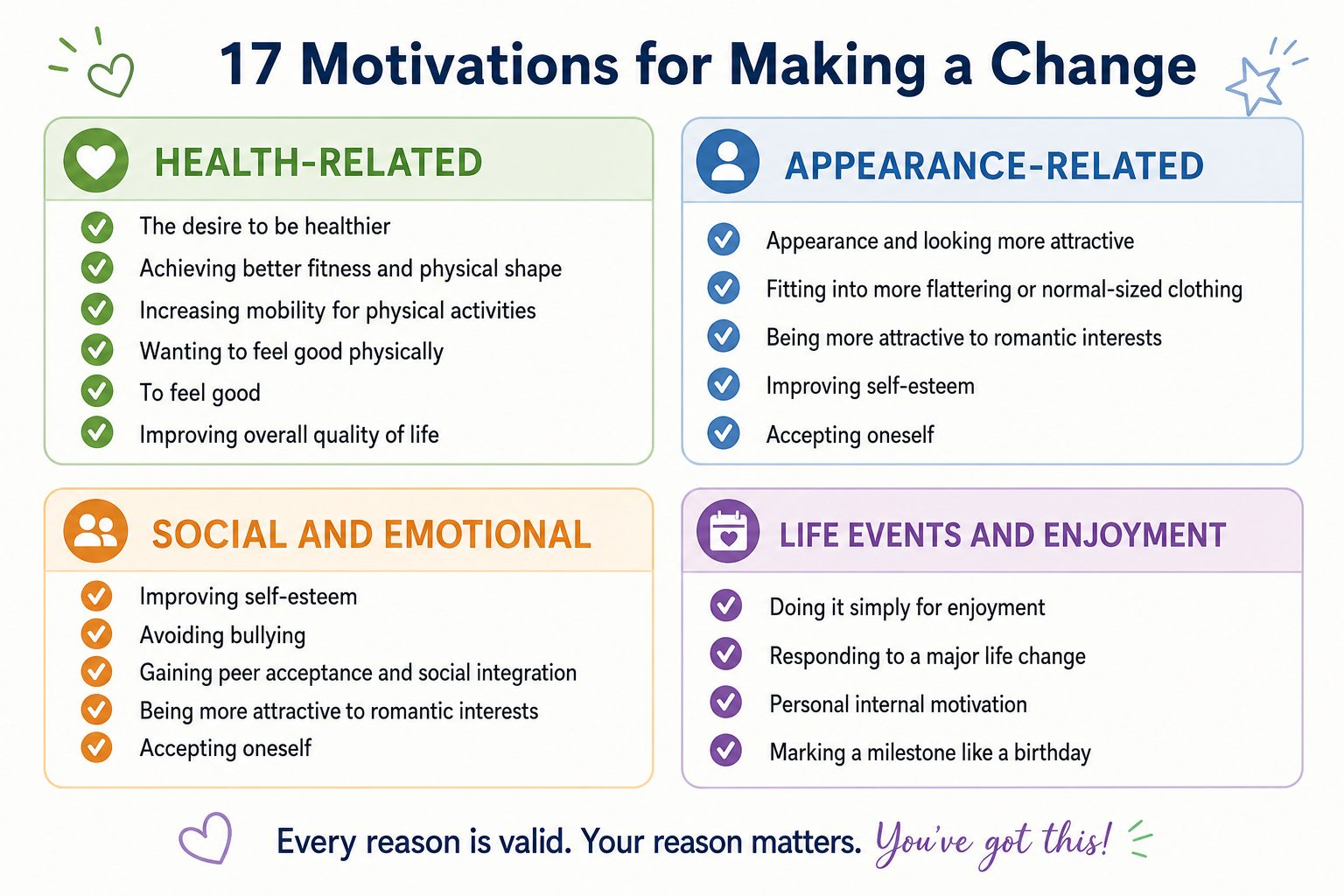
A systematic review published in BMC Pediatrics in 2018 set out to answer exactly this question: what actually motivates adolescents with overweight or obesity to want to lose weight? The researchers analysed six separate studies and identified 17 distinct motivations.
The study, published by Silva and colleagues in BMC Pediatrics, concluded that the main motivations adolescents reported were better health, appearance or cosmetic reasons, improvements in self-esteem, and avoidance of bullying or teasing.
Here are all 17 motivations identified in the research:
- The desire to be healthier
- Appearance and looking more attractive
- Improving self-esteem
- Avoiding bullying
- Achieving better fitness and physical shape
- Gaining peer acceptance and social integration
- Fitting into more flattering or normal-sized clothing
- Being more attractive to romantic interests
- Doing it simply for enjoyment
- Responding to a major life change
- Personal internal motivation
- Marking a milestone like a birthday
- Increasing mobility for physical activities
- Wanting to feel good physically
- To feel good
- Accepting oneself
- Improving overall quality of life.
Notice something important here. Health was the most commonly reported motivation across the studies reviewed, but it was far from the only one. Appearance, self-esteem, and social belonging showed up again and again too, and those motivations are just as valid as the health-focused ones.
Why It Matters That Health Isn't the Only Valid Reason
I want to spend a moment on this, because I think it is genuinely important.
As a pediatric endocrinologist, my own driving motivation for educating families is rooted in the long-term health risks of unhealthy weight gain. These risks are real and significant: higher risk for type 2 diabetes, obstructive sleep apnea, high blood pressure, fatty liver disease, depression and anxiety, joint pain, and even stroke and heart attack later in life.
But I also understand that a 14-year-old does not necessarily process the world the way an adult does, and may not fully grasp those distant future risks the way a parent or doctor might. That is completely normal for adolescent development. It does not mean health doesn't matter to them. It means their motivation might show up differently.
If your teenager's motivation is about feeling more confident, fitting into clothes they love, being able to keep up with friends during sports, or simply feeling good in their body, those are excellent, legitimate motivations. They do not need to mirror an adult's reasoning to be valuable. What matters is that the motivation is genuinely theirs.
Understanding the health risks behind unhealthy weight gain can still be useful context for families. My post on insulin resistance in teens explains the hormonal mechanisms driving many of these long-term risks.
How to Help Your Teenager Find Their Own Motivation
If none of these 17 motivations seem to resonate with your teenager, or if you are not sure what is actually driving their interest in getting healthier, here is a simple exercise worth trying together.
Write It Down: A Simple Strategy for How to Stay Motivated to Lose Weight as a Teenager
Ask your teenager directly: why is this important to you? Why do you want to make this change? Give them five or ten minutes, a piece of paper, and a pen, and ask them to write down their answer honestly.
Then put that piece of paper somewhere visible. Next to their bed, on the bathroom mirror, or saved as a screenshot on their phone. The reason this matters is simple: difficult moments will come. There will be days when motivation feels completely absent. Having a visible, personal reminder of their own words, written in their own voice, gives them something real to return to when that happens.
The Academy of Nutrition and Dietetics supports this approach, noting that clearly defined, personally meaningful goals are one of the strongest predictors of sustained behavior change, more so than goals imposed by someone else.
3 More Strategies to Keep Motivation High
Surround Your Teenager With a Supportive Environment
Motivation is heavily influenced by environment. If your teenager is trying to build healthier eating habits but spends most of their time with friends who order pizza every day, that environment is working against them, even if no one means any harm by it.
This does not mean isolating your teenager from their friends. It means being thoughtful about where extra support is needed, and finding at least some people, whether family or friends, who actively encourage the change rather than unintentionally making it harder.
Track Progress Beyond the Scale
One of the most powerful shifts a family can make is moving the focus away from weight and onto behavior. Keeping a simple journal of daily choices, not pounds lost, builds a much healthier relationship with progress.
This could be as simple as noting, today I had three servings of fruit and yesterday I had none. That is genuine progress, and it deserves to be recognised as such. Progress measured in habits, consistency, and small wins is far more sustainable and far less discouraging than progress measured only on a scale.
Make Specific, Conscious Decisions in Advance
Big moments, like parties or gatherings, are often where motivation gets tested the most. Rather than hoping willpower shows up in the moment, help your teenager make a specific decision ahead of time. Maybe it is choosing water instead of soda at the next party, or having two slices of pizza instead of five. Whatever the decision is, setting it in advance and then tracking and acknowledging that choice afterward builds real confidence over time.
Each small, conscious decision, tracked and celebrated, reinforces the identity of someone who follows through on their own goals. That identity, more than any single choice, is what sustains motivation long term.
For practical food swaps that make these conscious decisions easier, my post on why eat less move more fails teenagers explains what actually works instead of restriction.
Respecting Timing and Readiness
I want to address something important for parents specifically. If your teenager is trying to get to a healthier weight, start a conversation about what genuinely matters to them, and whether now feels like the right time for change.
Sometimes it is not the right time. Your teenager may not be ready, or may want to revisit this later, and that needs to be respected. I understand that not addressing the issue at all can allow things to get more difficult over time. But forcing change before someone is genuinely ready rarely produces lasting results, and can damage the relationship and trust needed for future conversations.
Keep the conversation open. Stay supportive. Respect their pace and their reasons, even when those reasons differ from what you expected.
Small, Consistent Steps Build Lasting Motivation
Understanding how to stay motivated to lose weight as a teenager starts with recognising that motivation is deeply personal, and that there is no single right reason to want a healthier weight. Whether your teenager's motivation is about health, confidence, sports performance, or simply feeling better in their body, all of these are valid starting points.
What sustains that motivation over time is not willpower alone. It is writing the reason down and keeping it visible. It is surrounding your teenager with people who support rather than undermine the change. It is tracking small wins instead of fixating on the scale. And it is making specific decisions in advance rather than relying on willpower in the moment.
Nobody can force healthy choices on anyone else. Lasting change happens when a teenager decides, for their own reasons, that the effort matters to them. Your role as a parent is to support that process, not control it.
Small habits, chosen and tracked consistently, really can produce huge results over time.
If you are also trying to understand where your teenager's current weight stands relative to a healthy range, my post on how much weight should my teenager lose walks through exactly how to think about that.
For 30 free high-protein recipes that make healthier choices easier day to day, visit lifestyleforteens.com/recipes.
NEXT STEPS
If your teen needs support to build these habits, this is exactly why I created the 100-Day LIFT Program — a pediatric weight management program that does not focus on dieting at all. It addresses the root cause: dysregulated insulin and the hormonal patterns behind the constant hunger, fatigue, and weight gain so many teens are quietly carrying. Over 100 days, we focus on steady blood sugar, protein-forward food, better sleep, calmer stress, and the specific kinds of movement that genuinely improve insulin sensitivity in teenagers.
There is no calorie counting. No food restriction. No shame-based language — because none of that works when the issue is biological, not behavioral.
And this is not an app. Parents and teens get direct, live access to me throughout the program — real conversations, real answers, real support. Not a chatbot. Not a feedback form. A pediatric endocrinologist who knows your teen and is walking the process with you, week by week.
Reach out to learn more, or book a free call with me to see if it is the right fit for your family.
For weekly guidance on teen metabolic health, hormones, and nutrition, I also share something new every week on my Lifestyle and Weight Loss for Teens podcast.
Frequently Asked Questions
What motivates teenagers to want to lose weight?
A 2018 systematic review published in BMC Pediatrics identified 17 distinct motivations for weight loss in adolescents. The most commonly reported were better health, appearance and cosmetic reasons, improved self-esteem, and avoidance of bullying. Understanding how to stay motivated to lose weight as a teenager starts with recognising which of these motivations genuinely resonates with your specific teenager, since motivation that comes from within tends to last far longer than motivation imposed from outside.
Is it normal for a teenager's motivation to lose weight to fade over time?
Yes, completely normal. Motivation naturally fluctuates for everyone, not just teenagers. This is why specific strategies like writing down your personal reason for change, keeping it visible, and tracking small daily wins rather than relying purely on willpower are so important. These strategies help sustain motivation through the inevitable periods when initial enthusiasm fades.
Should a teenager's weight loss motivation be about health or appearance?
Both are valid. While health-related reasons were the most commonly cited motivation in research, appearance, self-esteem, and social acceptance were also extremely common and legitimate motivations. A teenager does not need to be motivated purely by long-term health risks for their motivation to be valid or effective. What matters most is that the motivation is genuinely their own.
How can parents help support a teenager's weight loss motivation without pressuring them?
Start by opening a respectful conversation about what matters to your teenager and why, without imposing your own reasoning onto them. Help them write down their personal motivation and keep it visible. Create a supportive home environment with healthier food options readily available. Focus conversations on progress and small wins rather than weight or appearance. And respect their timing, since forcing change before someone is ready rarely produces lasting results.
What should I do if my teenager doesn't seem motivated to make healthier changes at all?
Timing matters. Sometimes a teenager genuinely is not ready, and that needs to be respected rather than forced. Keep the conversation open without pressure, and revisit it periodically. In the meantime, modeling healthy habits as a family, making nutritious food easily accessible, and avoiding shame-based conversations about weight all create an environment where motivation is more likely to develop naturally when your teenager is ready.
What is the best way to track progress that isn't just stepping on a scale?
Keep a simple daily journal focused on behaviors and habits rather than weight. Track things like servings of fruits and vegetables eaten, minutes of movement, or specific conscious choices made at meals or social events. Celebrating consistency and small improvements, such as eating more fruit this month than last month, builds a much healthier and more sustainable relationship with progress than focusing solely on the number on a scale.
About the Author
Dr. Jenny Gourgari, MD — Pediatric Endocrinologist & Obesity Medicine Specialist
Dr. Jenny is a board-certified Pediatric Endocrinologist and Obesity Medicine Specialist with 15+ years of experience helping teens with insulin resistance and prediabetes. She is the founder of Lifestyle for Teens and creator of the LIFT 100-Day Program. No diets. No shame. Just hormones that work.
Board Certified: Pediatric Endocrinology • Pediatrics • Obesity Medicine (ABOM) • MSc, Georgetown University • Full credentials →





No comment