


Healthy Snacks for Teenagers: What the Science Really Says About Snacking and Weight
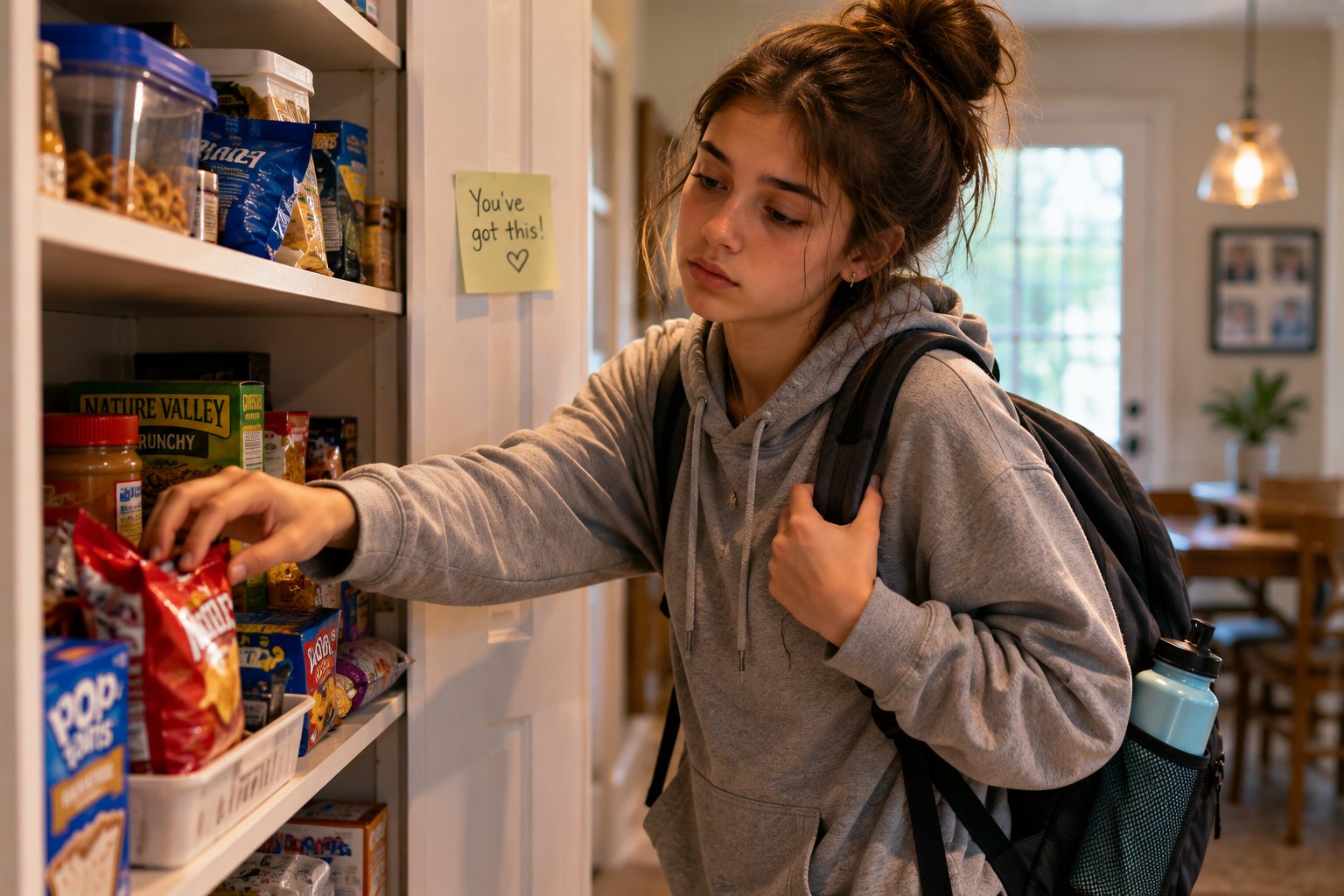
You know the scene. Your teen walks in from school, drops their bag by the door, and is elbow-deep in a bag of chips before they've even said hello. Maybe it's crackers. Maybe it's a sleeve of cookies vanishing while they “study.” And if you've ever quietly wondered whether all that after-school grazing is working against their health, you're asking exactly the right question — and the science around healthy snacks for teenagers has a genuinely hopeful answer.
Here's the part I most want you to hear before we go any further: this is not a willpower problem, and it is not a character flaw in your teen. The goal was never to get them to stop snacking. It's to be a little more thoughtful about what ends up in their hand. Let me walk you through what the research actually found — in plain English — and what you can do with it starting today.
What the Research Says About Healthy Snacks for Teenagers
In 2022, researchers published a study in the journal Obesity that dug into this exact question. They looked at 5,264 US teenagers between the ages of 12 and 19, using national health survey data (from NHANES, the National Health and Nutrition Examination Survey) collected over more than a decade. To start, they sorted teens into three groups based on body mass index, or BMI — basically a screening tool that flags whether someone is at a healthy weight, overweight, or has obesity. (If you'd like the plain-English version of BMI, I broke that down in our episode on understanding BMI.)
Then they compared the snacking between those groups. Here's what jumped out: teens in the obesity group ate about 603 calories a day from snacks. The overweight group averaged 527. And the healthy-weight group? 424. So roughly 100 to 180 extra snack calories a day separated the groups. And across all the teens, snacking made up about 22% of their total daily calories — roughly one-fifth of everything they ate, coming from snacks alone.
Pause on that for a second, because it's actually empowering. One-fifth of the daily plate is a place where small changes can add up fast. You don't have to fix every meal — and when it comes to healthy snacks for teenagers, the snack drawer is one of the highest-leverage spots in the whole house.
It's Not How Much They Snack — It's What's In the Snack
Here's the finding that changes everything about how we think about healthy snacks for teenagers. When researchers looked closer at what those extra calories were made of, the heavier groups weren't loading up on extra fruit, vegetables, or beans. The difference came almost entirely from refined grains, added sugar, solid fats, and oils — the white-flour-crackers, candy, and chips end of the spectrum.
In other words, it wasn't really that these teens snacked. It was what they were snacking on. And honestly, that's a freeing reframe for any parent who's been side-eyeing the pantry: the enemy was never the snack itself. It was the quality of the snack.
So if you've been telling your teen to “just eat less,” I'd gently invite you to set that script down. The science points somewhere more doable — and much kinder.
The Science, Simplified: Why Snack Quality Matters So Much
Let me explain the why in a way that actually makes sense, because once you see it, the case for higher-quality healthy snacks for teenagers clicks into place.
When your teen eats a snack that's mostly refined carbs and sugar — picture a fizzy drink and a pastry — their blood sugar spikes fast. To handle that spike, the body releases a hormone called insulin, whose job is to move that sugar out of the bloodstream and into storage. Useful in the moment. But that fast spike is usually followed by a fast crash an hour or so later, and that crash leaves your teen feeling hungry, foggy, and reaching for… another sugary snack. It becomes a loop.
And here's the compassionate truth in that: it's a hormonal loop, not a discipline failure. Your teen isn't weak. Their biology is doing exactly what it was designed to do with the fuel it was given.
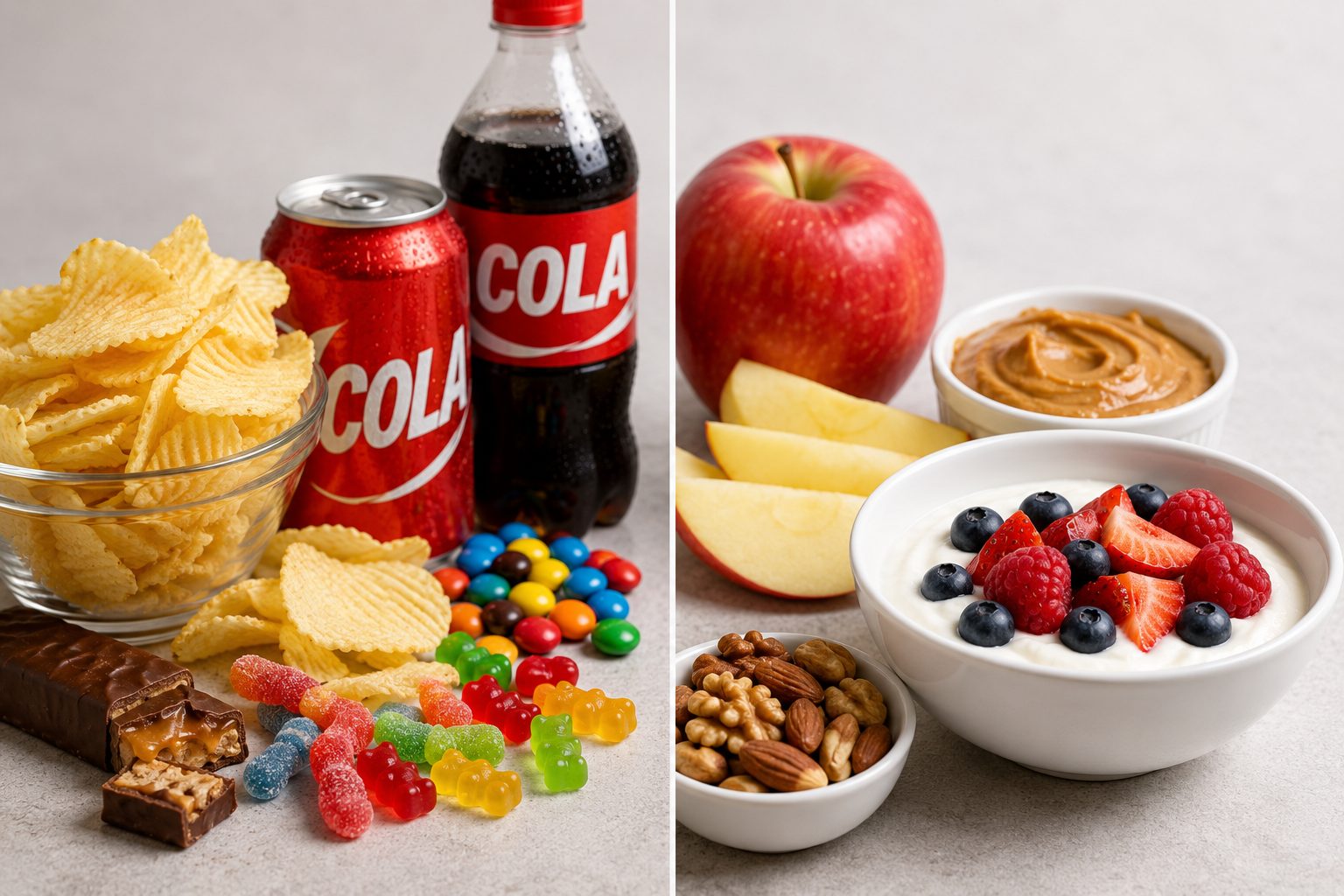
Now compare that to a snack with protein, fiber, and a little healthy fat — say, apple slices with peanut butter, or Greek yogurt with berries. That combination slows everything down. Blood sugar rises gently, insulin doesn't have to overreact, and your teen actually feels full for longer. Same number of bites. Completely different message to the body.
That's the whole game with healthy snacks for teenagers: you're not trying to shrink the snack or police every bite. You're trying to change the signal it sends to their hormones.
How to Choose Healthy Snacks for Teenagers That Actually Keep Them Full
So what does a genuinely satisfying snack look like? Here's a simple formula I come back to again and again: protein + fiber + a little fat. When you build healthy snacks for teenagers around those three things, you get staying power instead of a sugar crash. A few easy examples:
- Greek yogurt with berries and a sprinkle of granola
- Apple or banana slices with peanut or almond butter
- Whole-grain crackers with cheese or hummus
- A handful of nuts with a piece of fruit
- Hard-boiled eggs
- Veggie sticks with guacamole
Notice none of these are fancy, expensive, or hard to find. The goal isn't a perfect, Instagram-worthy snack board. It's a slightly better default — the thing that's easiest to grab when they're starving and standing in front of the fridge.
Small Swaps That Make a Big Difference
This is where I want you to start, because trying to overhaul everything at once almost never sticks. When you're building healthy snacks for teenagers into a real, busy week, momentum beats perfection — so pick one. Just one.
- Stock the easy stuff at eye level. Teens grab what's visible and ready. Put washed fruit, yogurt, cheese, and nuts at the front of the fridge and pantry, and tuck the chips toward the back. You're not banning anything — you're just changing what's easiest to reach.
- Add protein to what they already love. If they want crackers, add cheese. If they want a smoothie, add Greek yogurt or a scoop of protein. You're upgrading, not replacing.
- Keep one grab-and-go option always prepped. A container of cut veggies, a bowl of hard-boiled eggs, or pre-portioned nuts. Busy teens going from school to sports to homework need fast — so make the better choice the fast one.
- Crowd out instead of cutting out. Rather than declaring war on sweets (which tends to backfire), keep adding satisfying options. The good stuff naturally takes up more room.
- Bring your teen into it. Let them pick two new snacks at the store this week. A little ownership goes a long way toward making healthy snacks for teenagers something they actually reach for on their own.
Start with whichever of these feels easiest. One change, repeated often, beats five changes you abandon by Thursday.
The Bottom Line
If this feels like a lot, take a breath. You don't need a perfect kitchen, a meal-prep Sunday, or a teenager who suddenly craves kale. Healthy snacks for teenagers really do come down to small, repeatable habits — one better swap, made often enough that it quietly becomes the norm.
So let's drop the shame and the blame. Your teen isn't lazy, and you're not failing them. This is biology, hormones, and a few smarter defaults working in your favor. No shame — just hormones we can work with. Small habits, big results.
Want to make this dead simple? I put together a free guide — 20 Easy Snacks for Teenagers you can make at home in under 15 minutes, all built around protein and fiber so they actually fill your teen up instead of leaving them hungry an hour later. It's my shortcut for busy parents who want healthy snacks for teenagers without the overthinking. Grab it, stick it on the fridge, and let it do the thinking for you.
NEXT STEPS
If your teen needs support to build these habits, this is exactly why I created the 100-Day LIFT Program — a pediatric weight management program that does not focus on dieting at all. It addresses the root cause: dysregulated insulin and the hormonal patterns behind the constant hunger, fatigue, and weight gain so many teens are quietly carrying. Over 100 days, we focus on steady blood sugar, protein-forward food, better sleep, calmer stress, and the specific kinds of movement that genuinely improve insulin sensitivity in teenagers.
There is no calorie counting. No food restriction. No shame-based language — because none of that works when the issue is biological, not behavioral.
And this is not an app. Parents and teens get direct, live access to me throughout the program — real conversations, real answers, real support. Not a chatbot. Not a feedback form. A pediatric endocrinologist who knows your teen and is walking the process with you, week by week.
Reach out to learn more, or book a free call with me to see if it is the right fit for your family.
For weekly guidance on teen metabolic health, hormones, and nutrition, I also share something new every week on my Lifestyle and Weight Loss for Teens podcast.
Frequently Asked Questions
Are snacks bad for teenagers? Not at all. Nearly 90% of US teens snack daily, and snacks can absolutely add valuable nutrients like fruit, fiber, and calcium. The research suggests it's the quality of the snack — not the act of snacking — that's most strongly linked to weight. The best healthy snacks for teenagers add nutrients rather than empty calories, so focus on what's in the snack, not on eliminating snacks.
What are the best healthy snacks for teenagers for keeping them full? The most satisfying healthy snacks for teenagers pair protein with fiber and a little healthy fat — think Greek yogurt and berries, apple slices with peanut butter, or whole-grain crackers with cheese. That trio slows down blood sugar so your teen stays full longer and avoids the crash-and-crave loop.
My teen only wants chips and sweets — where do I start? Start by upgrading, not banning. Keep their favorites around, but make a better option even easier to grab — cut fruit at the front of the fridge, cheese next to the crackers, nuts in a visible bowl. Pick one swap this week and build from there. Crowding out works better than cutting out.
Does cutting out snacks help teens lose weight? The science points toward changing snack quality rather than cutting snacks entirely. In the research, the heavier groups weren't snacking on extra fruits and vegetables — the extra calories came from refined grains, added sugars, and solid fats. Swapping those for protein-and-fiber healthy snacks for teenagers is usually more sustainable than going cold turkey. For concerns about a specific teen's weight, it's always best to check in with your pediatrician or a registered dietitian.
How much of a teen's daily intake comes from snacking? On average, about 22% — roughly one-fifth of everything they eat in a day. That's exactly why the snack drawer is such a powerful place to make small, high-impact changes.
About the Author
Dr. Jenny Gourgari, MD — Pediatric Endocrinologist & Obesity Medicine Specialist
Dr. Jenny is a board-certified Pediatric Endocrinologist and Obesity Medicine Specialist with 15+ years of experience helping teens with insulin resistance and prediabetes. She is the founder of Lifestyle for Teens and creator of the LIFT 100-Day Program. No diets. No shame. Just hormones that work.
Board Certified: Pediatric Endocrinology • Pediatrics • Obesity Medicine (ABOM) • MSc, Georgetown University • Full credentials →




No comment