


Is Keto Safe for Teenagers? 5 Critical Truths Every Parent Must Know

Is keto safe for teenagers? It is one of the most common questions I get from parents, and I completely understand why. Your teenager is struggling with their weight. You have read about keto. You have seen the results people share online. It seems logical. Cut the carbs, lower the insulin, lose the weight.
I want to give you a real, honest answer to this question. Not a yes or no, because it is not that simple. What I want is for you to walk away from this post fully informed, so you can make the best decision for your teenager based on what the science actually says.
Let me start with a story. I will call her Sarah.
Sarah had a 14-year-old daughter who was gaining weight. She was always tired, always hungry, and craving sugar constantly. Her daughter was genuinely upset about how she felt in her body, and she wanted to do something about it. So she went online and found keto.
She started eating fewer than 20 grams of carbohydrates a day. She lost some weight initially. But after a few months, the restriction became unsustainable. She started eating normally again. The weight came back. And when she came to see me, she was exhausted, frustrated, and showing early signs of prediabetes.
Sarah had the best intentions for her daughter. She was a caring, concerned mom who just did not have a clear path. This is exactly why I wanted to write this post, because there are so many families in the same situation right now.
Is Keto Safe for Teenagers? What the AAP Report Actually Says
In 2023, the American Academy of Pediatrics published a report specifically addressing low-carbohydrate diets in children and adolescents. The full title is Low Carbohydrates in Children and Adolescents With or at Increased Risk of Diabetes. This is the document that paediatricians across the country refer to when counselling families who want to help their teenagers reach a healthier weight.
The American Academy of Pediatrics is the leading medical authority on child and adolescent health in the United States, and its guidance on this topic is worth understanding in full.
Before I break down what the report says, let me clarify what we mean by different types of low-carb eating, because these terms get used interchangeably, and they are not the same thing.
• A regular balanced diet gets about 45 to 65 percent of calories from carbohydrates.
• A low-carb diet brings that down to around 25 percent.
• A ketogenic diet goes much further, restricting carbohydrates to below 20 grams per day. This is the level at which the body enters ketosis, a metabolic state where it burns fat for fuel instead of glucose.
Keto works. The science on this in adults is solid, especially for adults with type 2 diabetes or insulin resistance. The body burns fat more efficiently, insulin levels drop, and weight loss follows.
But teenagers are not small adults. And this is the part that most online keto content never talks about.
Why Teenagers Are Different When It Comes to Low-Carb Dieting
A teenager's body is doing something that an adult's body is not. It is growing. Their brains are still developing. Their hormones are surging. Teenage girls in particular are in the process of establishing their menstrual cycles, which requires adequate nutrition and a stable energy supply.
When you restrict carbohydrates to extremely low levels during this window, you are not just changing what your teenager eats. You are potentially interfering with some of the most important biological processes of their entire life.
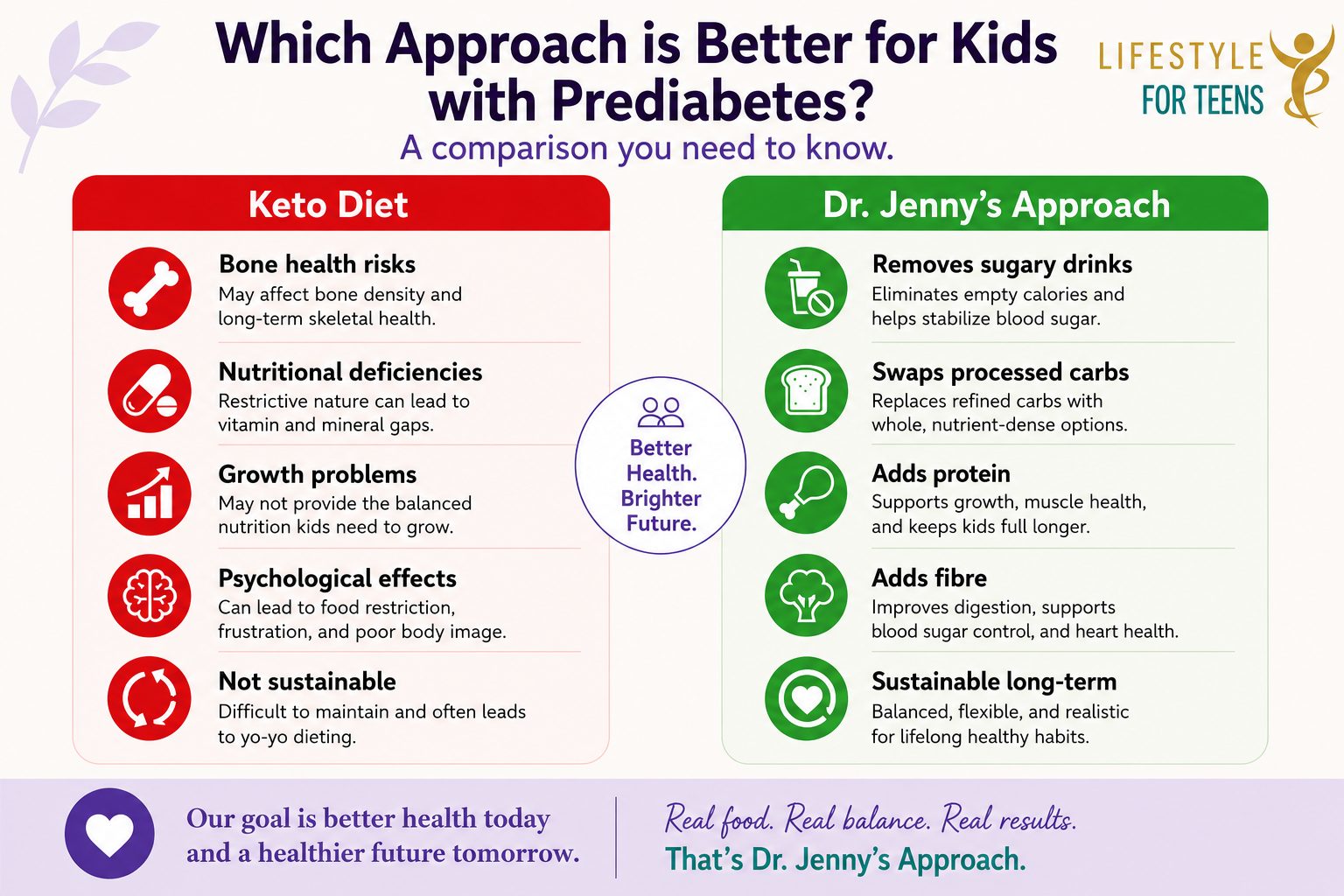
The AAP report raised specific medical concerns for teenagers on ketogenic diets, including abnormal bone health, nutritional deficiencies, and growth problems. For teenagers with type 1 diabetes, the report states that a strict ketogenic diet should only be undertaken under close medical supervision because the risks are significant.
For teenagers with prediabetes or type 2 diabetes, the risks are somewhat different but still present. And there is one more risk that almost nobody is talking about. The psychological one.
The Hidden Risk: Is Keto Safe for Teenagers Psychologically?
This is the part that concerns me most as a pediatric endocrinologist. And it is the part that most keto content leaves out entirely.
Research consistently shows that extremely restrictive diets are associated with body dissatisfaction, disordered eating, increased anxiety, and decreased mood in teenagers. These are not rare side effects. They are well-documented patterns that occur when teenagers are put under the stress of severe dietary restriction.
Think about what a teenager is already managing. Academic pressure. Social dynamics. Their body changing in ways they cannot control. Hormones creating emotional turbulence. Sleep disruption. This is already a lot.
Now add a diet that says you can have fewer than 20 grams of carbohydrates today. You cannot have the pizza at the party. You cannot have a birthday cake. You cannot eat what your friends are eating. For a developing teenager, this level of restriction does not just affect their body. It affects their relationship with food, their sense of belonging, and their emotional health.
And here is what I find most important to share with parents. These psychological effects do not always stay in the teenage years. Body image issues and disordered eating patterns developed in adolescence can follow a person into adulthood. This is not the foundation we want to build for our children.
If you want to understand more about the hormonal side of why teenagers struggle with weight, read my post on insulin resistance in teens, which explains exactly what is happening in their body and why it is not a matter of willpower.
So Is Keto Safe for Teenagers? Here Is My Honest Answer
The honest answer is that keto can produce short-term weight loss in teenagers, just as it does in adults. The biology is real. Cutting carbohydrates reduces insulin, and lower insulin means less fat storage. Sarah's daughter did lose weight initially.
But the question is not only whether keto works. The question is whether it is the right approach for a developing teenager, whether it is sustainable, and whether the risks are worth it.
Based on the AAP report, my clinical experience, and years of working with teenagers and their families, my answer is this: for most teenagers, keto is not the right tool. Not because it does not work at all, but because the risks to physical development and psychological health outweigh the short-term benefits. And because there is a better way.
The better question is not whether keto is safe. The better question is: what can my teenager eat more of, rather than what should they eliminate?
That shift in framing changes everything.
What a Typical Teen's Day Actually Looks Like (And Why It Matters)
Before I give you the four things I recommend instead of keto, I want to paint a picture of what I see in my practice all the time. Because I think it will help you understand why the solution is not an extreme restriction.
A typical teenager wakes up late because they stayed up too long the night before. They skip breakfast because there is no time. At school, they skip lunch, or they grab pizza or a burger. They come home at 3 pm absolutely starving and eat whatever they can find, usually chips, granola bars, or crackers.
Then there are after-school activities, homework, and stress. Dinner happens late. More snacks after dinner. And running through the whole day, there are sugary drinks, sodas, energy drinks, sports drinks, and sweetened teas.
The AAP report notes that around 50 percent of a teenager's calories can come from processed food, and up to 70 percent of their diet can include added sugars. Most teenagers are also falling far short of the recommended daily fibre intake.
This is not a teenager who needs extreme restriction. This is a teenager who needs better building blocks. And that is a completely different approach.
4 Things to Do Instead of Keto That Actually Work
These are the four changes I recommend to every family I work with. They are based on the same science that makes keto appealing, but without the risks. They work by improving insulin sensitivity gradually, naturally, and sustainably.
1. Remove Sugary Drinks First
This is the single most impactful change most teenagers can make. Sodas, fruit juice, sports drinks, energy drinks, and sweetened coffees are delivering pure sugar directly into the bloodstream with no fibre to slow it down.
Every one of those drinks causes an insulin spike. Replace them with water. That one change alone, done consistently, removes a significant source of the insulin elevation that is driving fat storage. Start here. It is the lowest-effort, highest-impact swap available.
2. Swap Processed Carbohydrates for Real Food Carbs
This is the important clarification that keto misses. The recommendation is not to eliminate carbohydrates. Not all carbs are the same.
Carbohydrates in lentils, Greek yogurt, blueberries, strawberries, and bananas are not the same as carbohydrates in a bag of chips or a packet of crackers. The former come with fibre, vitamins, and minerals that slow digestion and reduce the insulin response. The latter cause rapid spikes that drive fat storage.
Swap the chips for an apple. Swap the crackers for Greek yogurt. Swap the white bread for whole grain. You are still having carbohydrates. You are just having the ones that work with your teenager's body instead of against it.
3. Add Protein to Every Meal
Protein blunts the insulin spike that follows carbohydrates. When your teenager eats protein alongside their carbohydrates, the blood sugar rise is slower and smaller. The insulin response is more modest. They stay fuller for longer. Cravings reduce.
This does not require a complicated meal plan. A boiled egg at breakfast. Greek yogurt as a snack. A chicken breast at dinner. These small additions, made consistently, produce meaningful metabolic change over time.
For specific ideas, I have put together 30 free high-protein recipes designed specifically for teenagers that take under 30 minutes to make.
4. Add More Fibre Through Fruits and Vegetables
Fibre is one of the most underrated tools in a teenager's diet. It slows the absorption of sugar into the bloodstream, reduces blood sugar spikes, feeds beneficial gut bacteria, and keeps your teenager feeling full.
Most teenagers are nowhere near the recommended daily fibre intake. Adding one extra serving of vegetables to dinner, swapping juice for whole fruit, and choosing whole grains over refined grains are all simple ways to start closing that gap.
These four changes, done consistently, will improve insulin resistance. They will reduce the risk of prediabetes progression. They will support a healthier weight. And they will do all of that without the psychological cost of extreme restriction.
For more context on why these approaches work better than keto for most teenagers, Healthline's review of the keto diet for kids provides a helpful overview of the existing research and its limitations.
Start Small. Build Slowly. That Is How Real Change Happens.
I want to close with the message I give every family I work with, because I think it matters more than any specific dietary advice.
You are not going to make 100 changes in a week. That is not how lasting lifestyle change works. Identify two or three changes that feel doable for your family right now. Pick one from the four I listed above. Start there.
One small change every day. Over a year, that is 365 changes. That adds up in ways that will genuinely surprise you.
Progress is not linear. Some weeks will be better than others. None of this is your teenager's fault. Their cravings, their weight struggles, their energy problems, these are hormonal and biological, not a reflection of their character or their effort.
If your teenager has already been diagnosed with prediabetes, I also have a detailed post on the steps to reverse prediabetes in teenagers that walks through exactly what to do next.
Small habits, done consistently, can have enormous results. No extreme diets required.
YOUR NEXT STEPS:
- Want to understand the root cause of Prediabetes and Insulin Resistance in teenagers? Read: 7 Alarming Facts About Prediabetes in Teenagers Every Parent Must Know
- Teen already diagnosed with Prediabetes? Read: How to Reverse Prediabetes in Teenagers
- For weekly guidance on teen hormones and metabolic health, listen to the Lifestyle and Weight Loss for Teens Podcast
- Grab 30 free high-protein recipes that support healthy insulin levels — free at members.lifestyleforteens.com/f/30-easy-and-healthy-recipes-for-teens
Ready for real, structured support? The MINI LIFT Program is designed specifically for teen girls navigating PCOS, insulin resistance, and hormonal imbalances. A clear plan. Expert guidance. A community that gets it. No restriction. No shame. Just small, consistent habits that build real change. Join the MINI LIFT Program here.
About the Author
Dr. Jenny Gourgari, MD — Pediatric Endocrinologist & Obesity Medicine Specialist
Dr. Jenny is a board-certified Pediatric Endocrinologist and Obesity Medicine Specialist with 15+ years of experience helping teens with insulin resistance and prediabetes. She is the founder of Lifestyle for Teens and creator of the LIFT 100-Day Program. No diets. No shame. Just hormones that work.
Board Certified: Pediatric Endocrinology • Pediatrics • Obesity Medicine (ABOM) • MSc, Georgetown University • Full credentials →






No comment