


7 Honest Truths About GLP 1 Medications for Teens (Ozempic, Wegovy and More)

GLP-1 medications for teens are one of the most searched topics I see parents asking about right now. Ozempic, Wegovy, Saxenda. These names are everywhere. And as a pediatric endocrinologist who prescribes these medications in my own practice, I understand completely why families are curious, hopeful, and sometimes confused about what they actually mean for a growing teenager.
I want to give you a genuinely honest answer. Not a headline. Not a scare story. Not promotional content. A real, informed picture of what the clinical trials showed, what the numbers actually mean, and the one critical piece of information that almost nobody is reporting.
Because there is something buried in the research that changed how I think about this entire conversation, and once you understand it, I think it will change how you think about it too.
What Are GLP-1 Medications for Teens and How Do They Work?
GLP-1 stands for glucagon-like peptide-1. It is a hormone naturally produced in the gut that helps regulate blood sugar and appetite. GLP-1 medications for teens work by mimicking this hormone, which slows digestion, reduces appetite, and lowers the insulin spike that follows a meal.
The medications you have probably heard of most are semaglutide, which is sold under the brand names Ozempic and Wegovy, and liraglutide, sold as Saxenda. Wegovy was approved by the FDA in 2022 for teenagers aged 12 and older with obesity. Ozempic is approved for patients with type 2 diabetes, but semaglutide is the same active ingredient in both.
GLP-1 medications have been used in adults with type 2 diabetes for years. What is new is their use in teenagers for weight management, and the speed at which prescriptions are rising. Between 2023 and 2025, Wegovy prescriptions among teenagers aged 12 to 17 rose significantly.
Despite this increase, CDC reported <1% of teens were prescribed a medication in 2023. Researchers are calling for longer studies and closer monitoring of how these medications affect growing bodies over time. The short-term trial data is promising. The long-term picture for teenagers is still developing.
What the Clinical Trials on GLP-1 Medications for Teens Actually Showed
Let me walk you through how these trials worked, because the context matters enormously for understanding what the results actually mean.
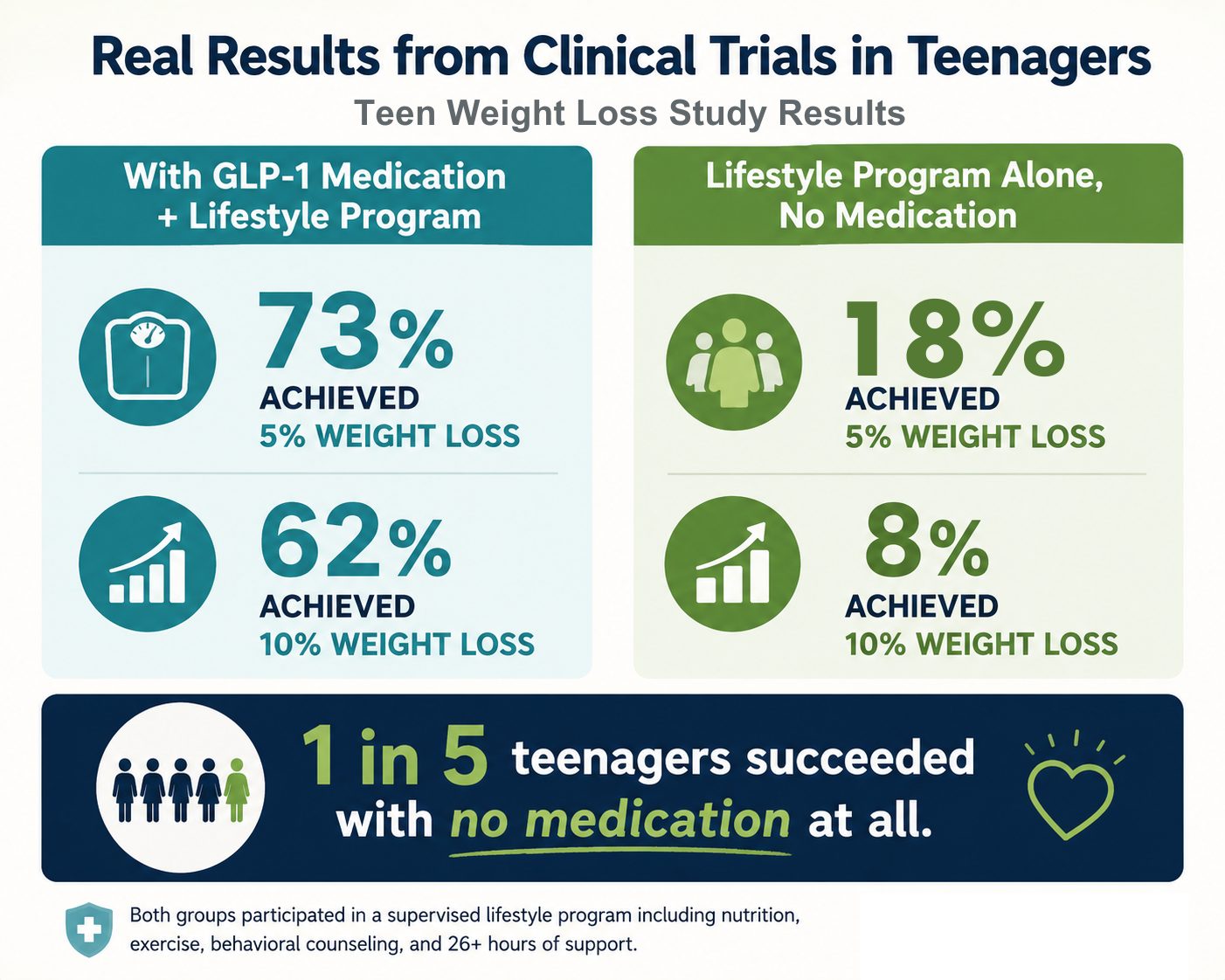
In every major GLP-1 trial for teenagers, the participants were divided into two groups. One group received the active GLP-1 medication, either Wegovy or Saxenda, alongside an intensive, supervised lifestyle modification program. The second group received a placebo, meaning a fake injection that looked identical to the real thing, but they were also enrolled in the same lifestyle modification program.
Both groups were seeing nutritionists. Both were doing structured strength exercises. Both received counseling to support their emotional health. Both had ongoing accountability and contact throughout the trial period.
Why This Matters
This matters because the impressive results you see in the headlines were produced while teenagers were inside a properly structured lifestyle program. Not alongside a casual recommendation to eat better and exercise more. A real, supervised, multi-contact program.
In the Wegovy and semaglutide trial, 73% of teenagers taking the GLP-1 medication alongside the lifestyle program achieved meaningful weight loss of 5% or more. That is the threshold researchers define as clinically significant, meaning enough to produce real metabolic benefit. 62% achieved 10% or more weight loss.
These are genuinely strong results. I am not dismissing them.
But now here is the number I want you to sit with.
23% of the teenagers who received no medication at all, who were only participating in the lifestyle modification program, also achieved that meaningful 5% weight loss.
Nearly 1 in 4 teenagers. No Ozempic. No Wegovy. No injection. Just structure, consistency, support, and time.
In the Saxenda and liraglutide trial, same results: roughly 1 in 5 teenagers achieve clinically meaningful results through lifestyle alone.
Why This Changes the GLP-1 Medications for Teens Conversation
Here is what makes that 1:5 result even more meaningful. In the Saxenda trial specifically, the teenagers in the lifestyle-only group had actually failed at lifestyle modification before they entered the study.
They had tried. It had not worked. They could not lose weight on their own. Then they entered a structured program with real professional support, real accountability, and real consistency over twelve months. And they got results.
This tells me something I have believed for a long time from my work with families. Many teenagers have not failed at lifestyle modification. They have tried lifestyle modification without the right structure around it. And those are very different situations.
To understand the hormonal reasons why unsupported lifestyle change is so hard for teenagers, my post on insulin resistance in teens explains the biological picture clearly.
The Side Effect Nobody Explains Properly
When parents ask me about side effects of GLP-1 medications for teens, the conversation usually focuses on nausea and stomach issues. These are real and worth discussing with your doctor. But there is another side effect that gets far less attention, and it is one I think every parent should understand before making this decision.
GLP-1 medications are associated with muscle mass loss during weight loss. When the body loses weight, it does not always lose fat and muscle in ideal proportions. Without adequate protein intake and regular strength training, GLP-1-driven weight loss can include a higher proportion of muscle loss than we would want.
For teenagers, this is a particularly important concern. Muscle mass during adolescence is not just about physical strength. It supports metabolic health, bone density, hormonal balance, and long-term weight management. Losing muscle mass during these years has consequences that go well beyond what shows up on a scale.
The good news is that this side effect is significantly reduced when strength training and high protein intake are part of the program alongside the medication. Which is exactly why the clinical trials that produced those strong results included structured strength exercise as a core part of the lifestyle modification program.
So if your teenager is taking or considering a GLP-1 medication, please make sure strength training and protein intake are part of the plan. Not optional extras. Essential parts of getting the maximum benefit with the minimum risk.
If you want ideas of high protein meals while your child is on GLP1 meds- grab my free guide of 30 high protein recipes here.
What Happens When Teenagers Stop GLP-1 Medications
This is one of the most important conversations I have with families before we discuss starting any GLP-1 medication, and I want to be completely transparent about it here.
When GLP-1 medications for teens are stopped, weight regain occurs. The research on this is consistent. The medications work by altering the hormonal signals that regulate hunger and appetite. When those medications are no longer present, those signals return.
I am not saying this to discourage anyone. These medications have a legitimate and meaningful role for many teenagers, and I prescribe them regularly. For some teenagers, the metabolic benefit during the period of use is significant and can genuinely change the trajectory of their health.
What I am saying is this. Medication changes outcomes while you take it. Lifestyle changes, once genuinely learned and made part of daily life, stay with you.
Nobody can take your habits away from you. If your teenager learns to choose whole foods over processed ones, to move their body consistently, to sleep well, and manage stress, those skills do not disappear when a prescription ends. That is the difference between a treatment and a transformation.
This is why I always encourage families to think of lifestyle modification not as an alternative to medication, but as the foundation that makes medication more effective and protects long-term results regardless of what happens with medication decisions over time.
What Proper Lifestyle Support Actually Looks Like
I want to be specific here because I think the phrase lifestyle modification is used so broadly that it has almost lost meaning for most families.
The official research recommendation is a minimum of 26 hours of contact support for lifestyle modification to be effective. Not a leaflet. Not a single appointment. Not a generic diet plan downloaded from the internet.
Twenty-six hours of real, ongoing interaction with professionals who understand what teenagers specifically need. Nutritionists, exercise physiologists, psychologists, or structured group programs with genuine accountability. Over time. With consistency.
This is how habits actually form. You can tell someone exactly what to do in one session. They will do it for a week. Then life happens, old patterns return, and without ongoing support, information alone is rarely enough to produce lasting change.
This understanding is directly behind why I created the 100-Day LIFT Program. Because I kept hearing the same story from families. They had tried. It had not worked. They had tried again. Still not worked. But what I observed was that the trying was happening without the right structure, without sufficient support, and often without the right understanding of what actually moves the needle for teenagers biologically.
If your teenager has been diagnosed with prediabetes and you are weighing your next steps, my post on how to reverse prediabetes in teenagers walks through the specific lifestyle steps the research supports most strongly.
How to Get the Most From GLP-1 Medications If Your Teen Is Already Taking Them
If your teenager is currently on Wegovy, Ozempic, Saxenda, or any other GLP-1 medication, this post is not meant to make you second-guess that decision. These medications work. They have a real role. And if your doctor has recommended them after weighing the risks and benefits, that recommendation came from clinical judgment informed by your teenager's specific situation.
What I want you to take from this is how to maximise what the medication can do. Because the trial results that made these medications famous, the 73% success rate with Wegovy, those results happened alongside a structured, intensive lifestyle program. Not instead of one.
Here is what that looks like in practical terms for your family:
- Regular strength training at least two to three times per week. This directly protects muscle mass and improves the metabolic benefit of the medication.
- Protein at every meal, aiming for at least 20 grams at breakfast, lunch, and dinner. Protein supports muscle preservation and stabilises hunger between meals.
- Remove sugary drinks completely and replace them with water. This is one of the most impactful single changes any teenager can make to reduce insulin spikes.
- Find structured support with real accountability. One appointment is not enough. Seek a program or professional relationship that can provide ongoing contact over months.
- Give it time. The research programs ran for a full year.
For free high-protein meal ideas to support your teenager alongside any medication or lifestyle program, I have created 30 free recipes specifically designed for teens that take under 30 minutes to prepare.
If You Have Tried Before and It Did Not Work, Please Read This
I want to close with something I say to almost every family that comes to me feeling defeated.
Failing at a previous attempt at lifestyle change does not mean lifestyle change cannot work for your teenager. It may mean the attempt did not have the right structure, the right support, or the right length of time to produce real results.
The Saxenda trial gave us a powerful piece of evidence for this. Teenagers who had previously failed at lifestyle modification on their own went on to achieve clinically meaningful weight loss when placed in a properly supervised, supported program for a full year.
One year. With consistency. With real support. And they got there.
This is not your teenager's fault. It is not your fault either. These are complex biological and hormonal systems operating in a developing body during one of the most challenging periods of human growth. Struggling with this is not a character flaw.
Small habits built consistently over time produce enormous results. That is not a motivational slogan. That is what the research on GLP-1 medications for teens and on lifestyle modification consistently shows us.
For weekly guidance on teen nutrition, hormones, and metabolic health, I share new information every week on my Lifestyle and Weight Loss for Teens podcast.
YOUR NEXT STEPS:
- Want to understand the root cause of Prediabetes and Insulin Resistance in teenagers? Read: 7 Alarming Facts About Prediabetes in Teenagers Every Parent Must Know
- Teen already diagnosed with Prediabetes? Read: How to Reverse Prediabetes in Teenagers
- For weekly guidance on teen hormones and metabolic health, listen to the Lifestyle and Weight Loss for Teens Podcast
- Grab 30 free high-protein recipes that support healthy insulin levels — free at members.lifestyleforteens.com/f/30-easy-and-healthy-recipes-for-teens
Ready for real, structured support? The MINI LIFT Program is designed specifically for teen girls navigating PCOS, insulin resistance, and hormonal imbalances. A clear plan. Expert guidance. A community that gets it. No restriction. No shame. Just small, consistent habits that build real change. Join the MINI LIFT Program here.
Common Questions
What are GLP-1 medications, and which ones are approved for teenagers?
What happens when teenagers stop taking GLP-1 medications like Ozempic?
Can my teenager lose weight without GLP-1 medications?
About the Author
Dr. Jenny Gourgari, MD — Pediatric Endocrinologist & Obesity Medicine Specialist
Dr. Jenny is a board-certified Pediatric Endocrinologist and Obesity Medicine Specialist with 15+ years of experience helping teens with insulin resistance and prediabetes. She is the founder of Lifestyle for Teens and creator of the LIFT 100-Day Program. No diets. No shame. Just hormones that work.
Board Certified: Pediatric Endocrinology • Pediatrics • Obesity Medicine (ABOM) • MSc, Georgetown University • Full credentials →




)
No comment